
Regional Focus – Greece Report
Greek owners urge ‘realism’ in any industry carbon plan
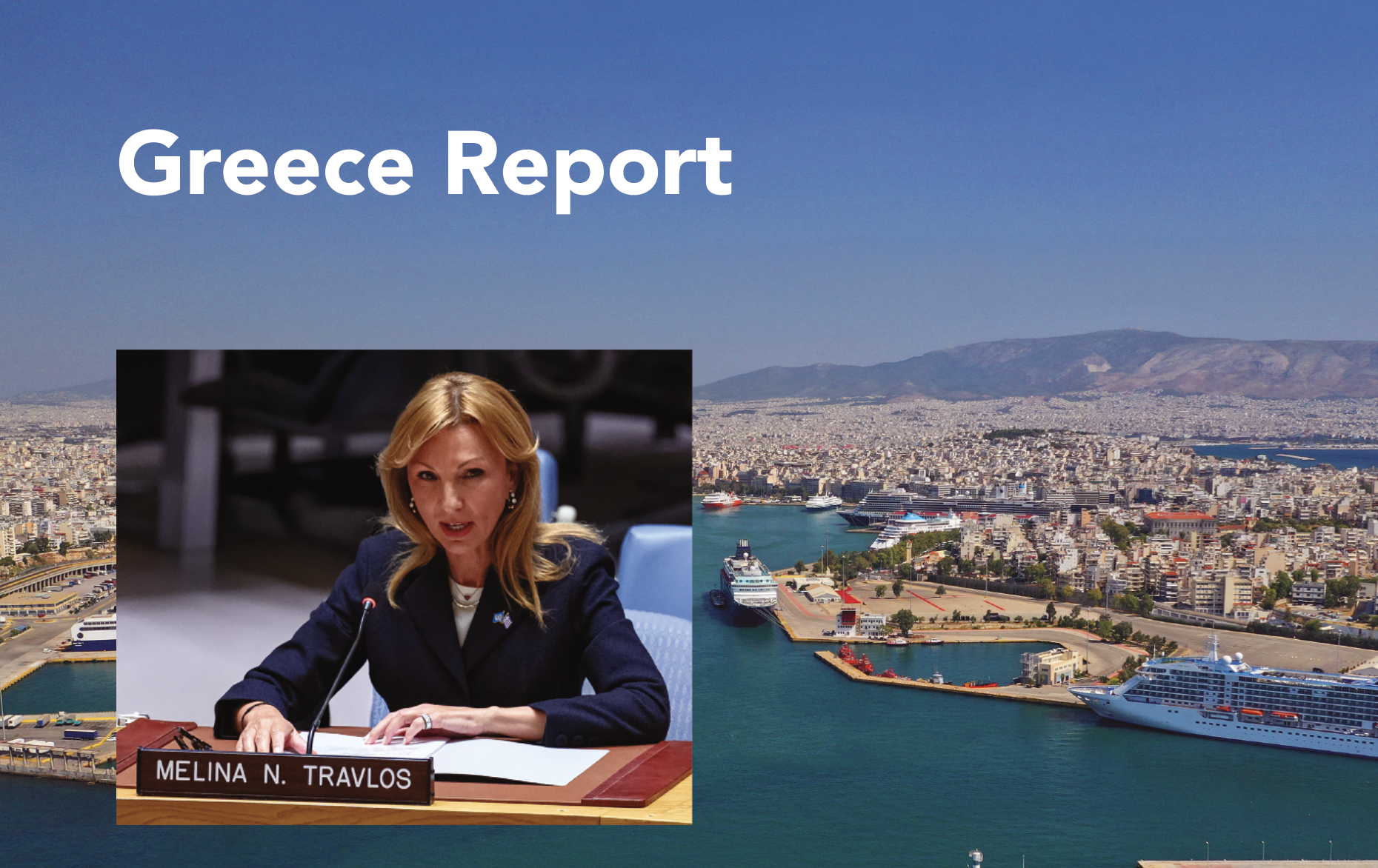
The Union of Greek Shipowners (UGS) rarely makes public pronouncements, but when it does they are usually worth careful consideration.
In mid-April, UGS President Melina Travlos issued a statement on the forthcoming IMO MEPC 84 session, where talks were to resume on the thorny issue of the international body’s proposed Net Zero Framework (NZF). The plan failed to attract consensus approval at MEPC 83 last October, with Greece reported to have departed the official EU position of supporting the NZF and been ready to abstain in any vote, that in the event was postponed for a year with preparatory discussions to resume at MEPC 84.
“With the global shipping industry turning its attention to the upcoming session of the International Maritime Organization’s Marine Environment Protection Committee,” began the mid-April statement, “the Union of Greek Shipowners calls upon all Member States to rise to the occasion in a spirit of pragmatism and constructive cooperation.
“Greek shipping, representing the largest cross-trading merchant fleet in the world, has consistently been at the forefront of environmental stewardship. The Greek shipowning community continues to invest substantially in fleet renewal, energy efficiency and technological innovation, demonstrating that operational excellence and environmental responsibility go hand in hand.
We remain firmly committed to the decarbonisation of our sector.”
And then came the kicker: “However, ambition must be grounded in realism. The draft Net-Zero Framework (NZF) does not constitute an appropriate solution, as evidenced by the absence of support from major and influential States representing a significant share of global tonnage, an element that cannot be overlooked.
“We therefore urge Member States to work towards a global, realistic and implementable solution that can ensure a just and equitable transition, while prioritising safety and providing the necessary certainty for long-term investments. Failing this, the risk of a fragmented regulatory landscape, marked by regional measures that distort competition, will become inevitable.”
The statement ended: “In this context, we call upon governments to match the industry’s commitment with the necessary political will and determination.”
Earlier, the Chairman of the London-based Greek Shipping Co-operation Committee (GSCC), Haralambos J. Fafalios, had been even more forthright in his remarks at the body’s Vasilopita cake-cutting reception held in early January, where IMO Secretary-General Arsenio Dominguez was guest of honour.
Lamenting that no sufficient supply of suitable alternative fuels was yet available, he criticised the regulatory approach to date for having been “all stick and no carrot”.
“Shipping needs global solutions and tramp shipping in particular, which encompasses the largest part of the world shipping fleet, cannot rely on haphazard solutions which are not yet there in terms of reliability and, more importantly, in terms of safety,” Fafalios said.
“The carbon-free solution is still not around and will not be so for the next 10-20 years and therefore levying more taxes will not encourage a cleaner world. Those who are levying these taxes should be responsible for finding the real solutions.”
He continued: “With regards to the IMO NZF, unless the world shipping industry can be directly involved in the drafting of this legislation, it cannot be anything more than window dressing. More taxes only mean a greater burden for the consumer since it is they alone who will pay.”
All of which suggests that what is generally considered the world’s largest shipping nation will not be a willing party to any revival of the NZF in its current format, despite IMO’s stated intention that a one-year pause on debating its adoption was merely a ‘postponement’.
Meanwhile, great strides in energy efficiency and emissions reduction are already underway with existing design ships, the GSCC Chairman pointed out, and this is borne out by the number of vessels among Greek shipowners’ voluminous fleets and newbuilding orders that are dual-fuel-capable, scrubber-fitted and/or fitted with energy saving devices. Leading Greek shipowners are also involved in joint technical efforts on decarbonisation such as Athens-based non-profit collaboration the Maritime Emissions Reduction Centre (see following article).
Desirable’ vs. ‘doable’
One Greek owner involved in particularly aggressive fleet expansion – and a staunch opponent of the NZF in its current form - is Dynacom group founder George Procopiou, who has as many as 80 new vessels on order, the vast majority at Chinese yards including much-in-demand Hengli Heavy Industries
Receiving a special award at the 30th anniversary celebration of the Hellenic Chinese Chamber in late 2025, Procopiou recounted how in total he had ordered some 160 ships in China since 2000. He praised the Chinese for being a “reasonable” people who could see the difference between the “desirable” - which he said as “is what politicians promise” - and the ‘doable’ - what businesses can actually deliver.
Decarbonisation was desired by all at IMO but China (and others) in the end opposed the IMO’s NZF plan because they realised it was not ‘doable’, ran Procopiou’s argument.
The shipowner went on to point out that despite China being “very advanced in all sectors of renewables simultaneously”, the country continues to “push all the other forms of energy,”. And it’s that mix of crude oil, coal, gas, wind, hydroelectric, nuclear, solar etc, that is now needed, he said, calling it an “energy addition” rather than “energy transition”.
Echoing the sentiments of UGS President Melina Travlos, Procopiou declared that “cooperation, not confrontation, should be the motto of our times.”
In short, Procopiou and fellow Greek shipowners seem to be pushing for a more inclusive, less punitive, approach to decarbonisation going forward. Advancing at a realistic pace with a ‘coalition of the willing’ leading the way, one might say, rather than a route march at breakneck speed that is enforced on all.
Shipping’s neutrality
The UGS, and Ms. Travlos personally, have also been very outspoken on the issue of military attacks on commercial vessels, and excerpts from their statement made at the beginning of the year remain even more relevant today.
“Shipping is not a battlefield and it should not be used or targeted as a means of political pressure,” declared the UGS President. “As I also stated at the United Nations Security Council in May 2025, shipping should be kept out of fields of geopolitical tension and military confrontation. Seafarers are civilians … [and] protection of seafarers and freedom of navigation are not optional, they are fundamental European and international obligations.
“As Greek shipping, we have consistently served and continue to serve peace, cooperation, and stability. … The European Union must immediately take steps, in a coordinated and decisive manner, to protect its shipping industry, its people, and the strategic role shipping plays in the prosperity of Europe and its citizens.
It must make it clear that no attack on civilian vessels is acceptable and no threat against seafarers can be tolerated.
“Shipping connects the world, and no geopolitical argument can justify it being violently targeted.”