
News Watch: Strait of Hormuz remains ‘theatre of uncertainty’
It all seemed so easy in mid-June when the US and Iran finally signed an MOU for a 60-day ceasefire that was intended to pave the way to a definitive peace deal, and in the meantime allow vessel traffic to resume transits of the Strait of Hormuz unhindered.
“Ships of the world, start your engines and let the oil flow”, US President Donald Trump declared on social media.
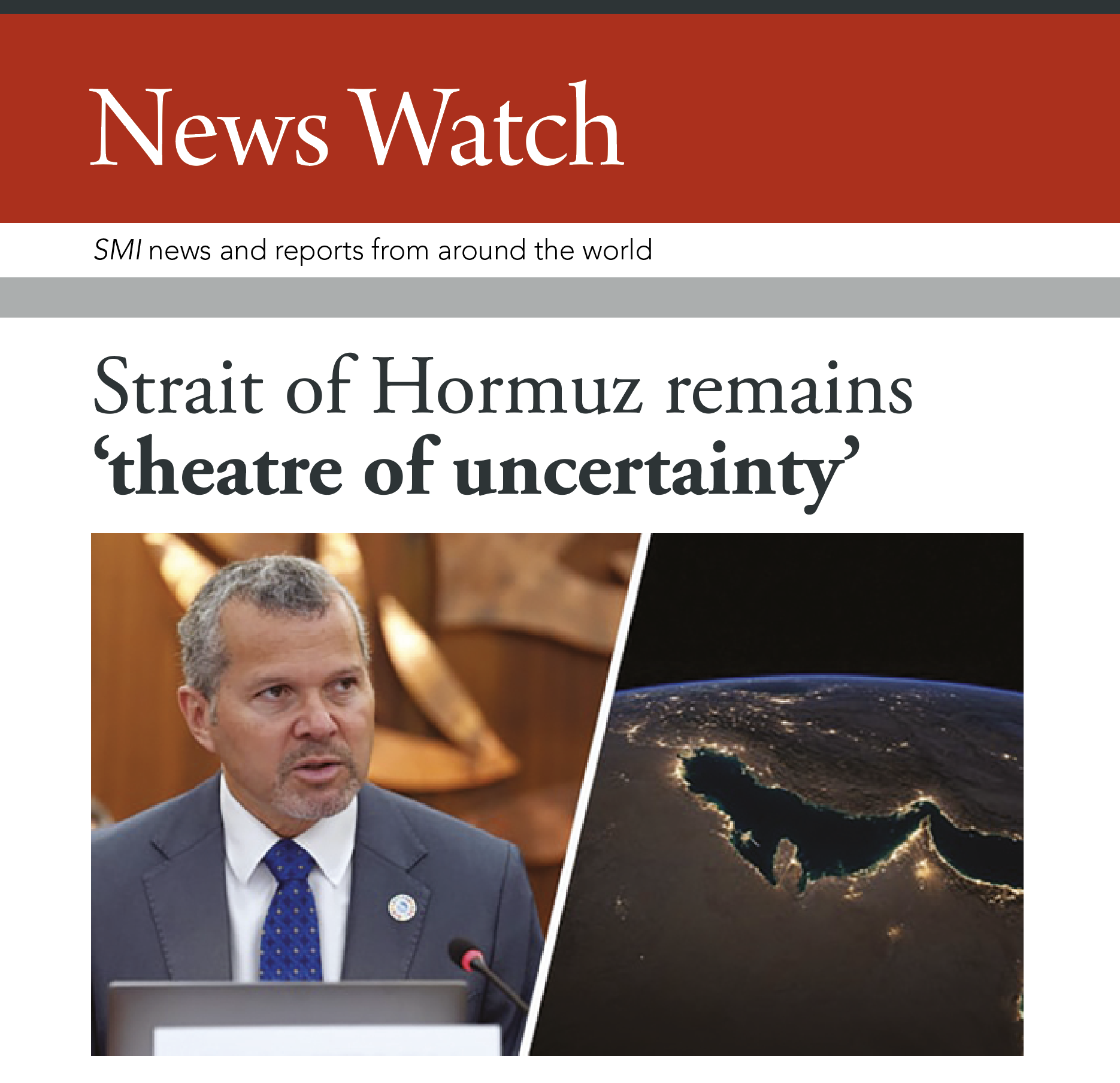
Shipping leaders welcomed the move. “This signals a crucial return to peace, dialogue, multilateralism and diplomacy, and in particular, an important step toward restoring safety in this vital maritime corridor for seafarers and ships, as well as safeguarding the fundamental principle of freedom of navigation,” International Maritime Organization (IMO) Secretary-General Arsenio Dominguez (pictured) said in a statement.
International Chamber of Shipping (ICS) Secretary General Thomas Kazakos concurred: “This announcement comes as a relief to the 20,000 seafarers who have been caught in the middle of this war. Their safe departure from the region must be a top priority but will take time.”
BIMCO already sounded a prescient warning note, however. “The statements by the US and Iran are currently unclear and do not offer sufficient information regarding key aspects such as timings and safe routes,” said the association’s Chief Safety & Security Officer, Jakob Larsen. “Due to lack of details and a history of overly optimistic reassurances, we believe the security situation for the shipping industry remains volatile, and we still consider it very risky for ships to commence transits at this point.”
Undeterred, the IMO pushed ahead with drawing up a Hormuz Evacuation Plan, which it issued just over one week later after a number of vessels had already exited the Gulf. “We will begin the implementation of the evacuation plan for over 11,000 seafarers still stranded in the region,” stated the IMO Secretary-General. “This large-scale operation will be carried out in close cooperation with Iran, Oman, all other coastal States in the region, the United States and the maritime industry. We have secured the necessary safety guarantees and have thoroughly verified the conditions for safe navigation to support these operations.”
The IMO followed up with a series of Operational FAQs about how ships should follow the Plan in order to exit the Gulf through the Strait of Hormuz. This envisaged use of one of two possible routes – a Nothern (Iran) Corridor and Southern (Oman) Corridor – to avoid the main channel that had been mined earlier during the US/Israel-Iran conflict that began 28 February,
The US was quick to encourage vessels to use the southern route, thereby not having to submit to any fees or conditions that Iran would enforce. But the Iran Revolutionary Guard Corp ominously declined to recognise the validity of the Oman corridor, publicly warning that it would be “dangerous’ for ships to try to use that. According to maritime intelligence service Windward, vessels embarking on the route were contacted by the IRGC and warned to turn back. This followed Iran’s founding, in early May, of a Persian Gulf Strait Authority (PGSA) to manage transits through the Strait of Hormuz with claimed authority over the entire breadth of the waterway.
Then on Thursday June 25, Singapore-flagged Evergreen containership Ever Lovely sustained minor damage to the bridge area from an “unknown projectile” off the Oman coast while leaving the Strait of Hormuz. All 21 crew members were reported safe and the vessel was able to continue on its voyage.
The IMO pointed out that the vessel had not followed all the points of the Evacuation Plan, for example failing to alert the Omani Navy of its intended passage. But nonetheless, in the interests of seafarer safety, it decided to pause the Evacuation Plan while it gathered further details of the attack and pending guarantees from all parties involved that no more attacks on innocent seafarers would take place.
The US authorities claimed that Iran had in fact launched drone attacks on four vessels off Oman, with just the
Ever Lovely hit. President Trump called it a “foolish violation” of the 60-day ceasefire agreement, and the US military retaliated with air strikes on Iranian missile and drone storage facilities and coastal radar positions.
Another drone strike in the Strait occurred, this time against a Panama-flagged vessel, and the US retaliated again with more strikes, before both sides reportedly agreed to stand down hostilities.
IMO Secretary-General Arsenio Dominguez had meanwhile convened a press briefing on 25 June in which he defended the initial success of the Evacuation Plan, pointing out that some 115 vessels carrying 2,500 seafarers had successfully transited the Strait and left the Gulf in the three-and-a-half days the evacuation plan was in force, he said, This left around 500 vessels and 8,500 seafarers still trapped in the Gulf, with the safe evacuation of these remaining IMO’s priority, he said, followed by a de-mining of the Strait.
Questioned by journalists about whether Iran had ever approved the Omani route, the Secretary-General stressed that IMO had been following a multilateral approach, and that is was not up to IMO to advise shipowners on what route to take. This left the distinct impression that Iran had not approved the Omani route, suggesting the safety of its use remained in question.
Tanker owners’ association INTERTANKO issued a statement immediately after the Secreatry-General’s briefing, calling for a diplomatic solution to what it dubbed a ‘crisis’ situation.
“This latest development highlights the fragile nature of the situation in the Strait of Hormuz and the urgent need for a diplomatic resolution to resuming safe transits,” said Tim Wilkins, MD of INTERTANKO.
INTERTANKO was advising Members that, if possible, they should delay transits through the Strait until the situation became clearer. However, if they were planning to use the Southern (Oman) route then they should contact the US Navy to ensure the latest information regarding the threat and route is available, it added.
“The Northern (Iranian) route remains a cause for concern, due to the requirements of the Persian Gulf Strait Authority (PGSA) that present sanctions, contractual and insurance risks to owners.” INTERTANKO stated.
“Despite the relative initial success of the IMO plan, as well as the wider routeing, there are issues and ambiguities that need to be addressed in any follow-up measures to ensure safe navigation,” the tanker body continued.
INTERTANKO’s Marine Director, Phillip Belcher, said: “We would like to see more active vessel traffic management, and 24/7 transits through the routes as we feel it is the best way to ensure full, pre-conflict-level numbers are resumed, while providing navigation safety for the seafarer.”
Furthermore, “INTERTANKO continues to raise concerns over the long-term implications of the US-Iran MoU, and would like clarity on the 60-day limit and planned imposition of mandatory Iranian insurance. Joint statements by both Iran and Oman have indicated that costs will be imposed on traffic. The 60-day negotiation deadline and recent announcements create significant uncertainty and added pressure on owners and seafarers when considering safe transits.”
INTERTANKO MD Wilkins added that the imposition of fees “of course, goes against UNCLOS in that vessels’ rights to transit are seemingly revoked with freedom of navigation being ignored.”
But Iran's chief negotiator, Mohammed Bagher Ghalibaf, was reported as having told state-affiliated news outlets that "everyone should know that the administration of the Strait of Hormuz will never go back to the way it was before the war" [see also Straight Talk p8].
In the words of one captain of a trapped ship that appeared in the maritime press, the daily reality of manning a ship in the Strait of Hormuz has become “theatre of uncertainty”. Add in the fact that drone strikes continue on vessels using the approved corridor in the Black Sea, with at least two seafarer fatalities occurring in separate attacks in late June, and ‘freedom of navigation’ seems to have become a rather quaint notion for now in these geopolitically troubled times.