
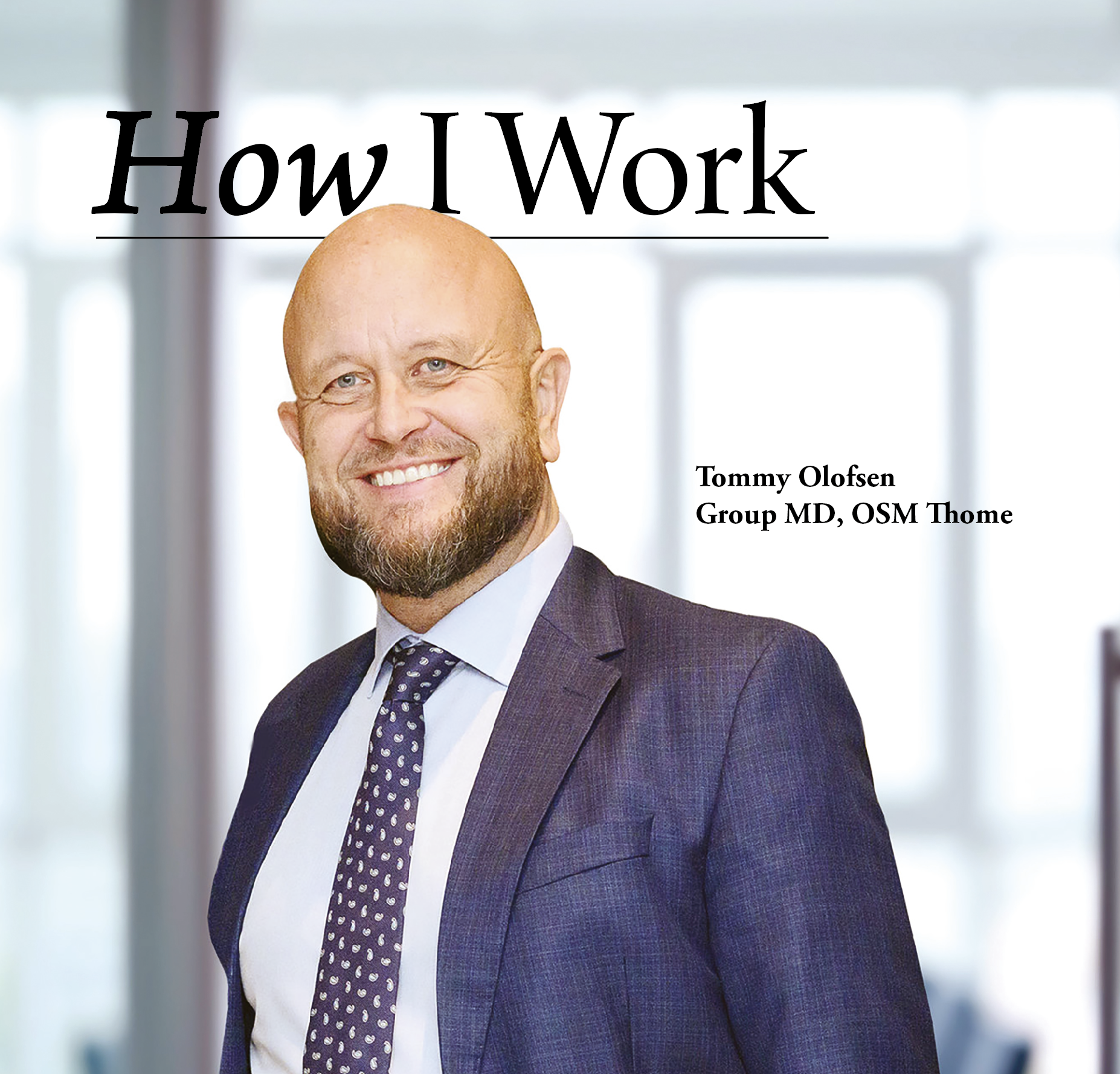
How I Work: Tommy Olofsen, Group MD, OSM Thome
Leadership, not cost, will define the next era of ship management
Why OSM Thome’s Tommy Olofsen believes the future belongs to performance, partnership and people
By Sean Moloney
The ship management industry is undergoing one of the most significant transformations in its history. For years, third-party managers were often judged on one metric above all others: cost. Today, however, that conversation is changing. Shipowners are increasingly looking beyond operational expenditure and asking a far more strategic question: who can help them navigate an industry that has never been more complex?
Few people are better placed to comment than Tommy Olofsen, Group Managing Director of OSM Thome. Leading one of the world’s largest ship management companies, with responsibility for more than 1,000 vessels, over 30,000 seafarers and approximately 1,600 shore-based employees across more than 20 countries, Tommy Olofsen believes ship management is entering a new phase where resilience, expertise and partnership matter more than price.
“The dynamics are changing from being mainly a question of cost to becoming much more a question of performance, reliability and infrastructure,” he explains. “Ship managers are becoming a key part of a shipowner’s ability to deliver what their business needs.”
It is a subtle but fundamental shift.
Historically, many shipowners built their businesses around a single market segment—containers, tankers, dry bulk or offshore. Increasingly, however, owners are diversifying fleets and trading patterns, creating new operational challenges.
This is where large third-party managers are finding new relevance.
“We manage more than 40 different vessel types across the world,” he says. “That gives owners access to expertise they simply may not have internally. It creates opportunities for much deeper strategic partnerships.”
Rather than replacing in-house management, third-party managers are increasingly complementing it, allowing owners to expand into unfamiliar sectors while reducing operational risk.
The drivers behind this evolution are numerous: regulatory compliance, geopolitical uncertainty, ESG expectations, new fuel technologies, charterer requirements and digital transformation all add layers of complexity to vessel operations.
“The most important thing is building sufficient scale and robustness to handle whatever comes our way,” he says.
For Tommy Olofsen, the industry’s fixation on operating costs misses a much larger commercial reality.
Saving a small percentage on crewing or maintenance means little if the consequence is poor vessel performance, off-hire periods or Port State Control detentions.
“You might save a few percentage points on OPEX, but if that results in performance issues, you’ve destroyed value at an entirely different level.”
It is a philosophy that reflects how many charterers and cargo owners are now assessing shipping partners. Operational reliability, safety records and fleet performance increasingly influence commercial decisions.
Ship management, once viewed as an outsourced operational necessity, is becoming an enabler of competitive advantage.
Since becoming Group Managing Director in late 2025, Tommy’s first priority has not been technology or commercial growth, it has been alignment. “My immediate priority has been getting everyone to work as one.”
That philosophy extends across every part of the organisation, from ships at sea to finance departments ashore.
“It doesn’t matter whether you’re onboard, in HR, crewing, accounting or leadership,” he says. “Every one of our 30,000 colleagues represents who OSM Thome is.”
Creating a common culture is particularly important in a global business where operational consistency directly affects safety, customer experience and crew welfare. Equally important, he believes, is how organisations respond when things go wrong.
“The way we handle challenges defines who we are just as much as when everything goes according to plan.”
If there is one theme that consistently returns throughout the conversation, it is people.
While much of shipping’s public debate remains focused on decarbonisation and technology, Tommy Olofsen believes attention has rightly shifted back towards the individuals who keep global trade moving.
“I don’t think enough attention is paid to seafarers,” he says without hesitation. “It is improving, but it’s nowhere near where it should be.”
The International Day of the Seafarer theme, Carrying World Trade, Carrying the Risk, resonates strongly with him. “It isn’t the steel of the ship or the fuel in the engine room that powers world trade. It’s the people.”
He argues that the industry still frequently undervalues seafarers, pointing to outdated terminology and employment practices that fail to reflect today’s highly skilled maritime professionals.
Perhaps most notably, OSM Thome directly employs its own seafarers rather than relying solely on external employment structures, a model Olofsen believes fundamentally changes the relationship.
“When we employ them ourselves, they become our colleagues.
That changes everything.”
Recent geopolitical tensions have once again highlighted the pressures facing crews operating in high-risk regions. And Mr Olofsen acknowledges that today’s seafarers face increasing levels of fatigue, stress and isolation.
“What concerns me most is keeping the promise we make, not only to the seafarer, but to their family, that they return home in the same condition they left.”
To support crews, OSM Thome has invested heavily in welfare infrastructure, including its own medical clinics, doctors and psychologists alongside enhanced communication and welfare protocols. For Tommy, however, welfare begins with something much simpler. “It starts with treating seafarers with respect.”
He is equally clear that organisations cannot simply talk about putting people first.
“If you say seafarers matter, every action has to support that. Otherwise you’ll be called out very quickly.”
Artificial intelligence dominates almost every industry discussion today, but he adopts a notably measured approach. Rather than rushing to deploy AI tools, OSM Thome has focused on fixing processes first. “If your processes are poor and your data is poor, AI simply automates poor processes using poor data.”
Instead, the company has developed a structured digital roadmap, ensuring work processes are standardised before automation is introduced. Only then, he says, can digital tools genuinely improve efficiency. The objective is not to burden crews with additional systems but to reduce administrative workload.
“We want people spending less time entering data and more time using information to make better decisions.”
It is a pragmatic approach that reflects a broader industry realisation: digitalisation succeeds only when it supports operational objectives rather than becoming an objective in itself.
Despite rapid technological change, Tommy Olofsen remains convinced that leadership, not software, will determine future success. His own philosophy centres on trust, accountability and empowering others.
“I don’t overload people with tasks,” he says. “I overload them with accountability and responsibility.”
It is an approach that enables decision-making throughout the organisation while allowing leaders to step back rather than attempting to control every operational detail.
“I surround myself with people who are better than me,” he says with a smile. “That means I can sleep well because they do a good job.”
Listening to Tommy Olofsen, it becomes clear that ship management’s future will not simply be shaped by larger fleets, smarter software or lower operating costs. It will be defined by trust.
Trust between owners and managers. Trust between shore and ship. Trust between employers and seafarers.
As compliance grows more demanding, geopolitical uncertainty becomes more persistent and technology reshapes operations, ship management companies are evolving from outsourced contractors into strategic partners central to fleet performance.
For Olofsen, the industry’s future rests on a simple principle: Performance creates value.
And performance begins, and ends, with people.