
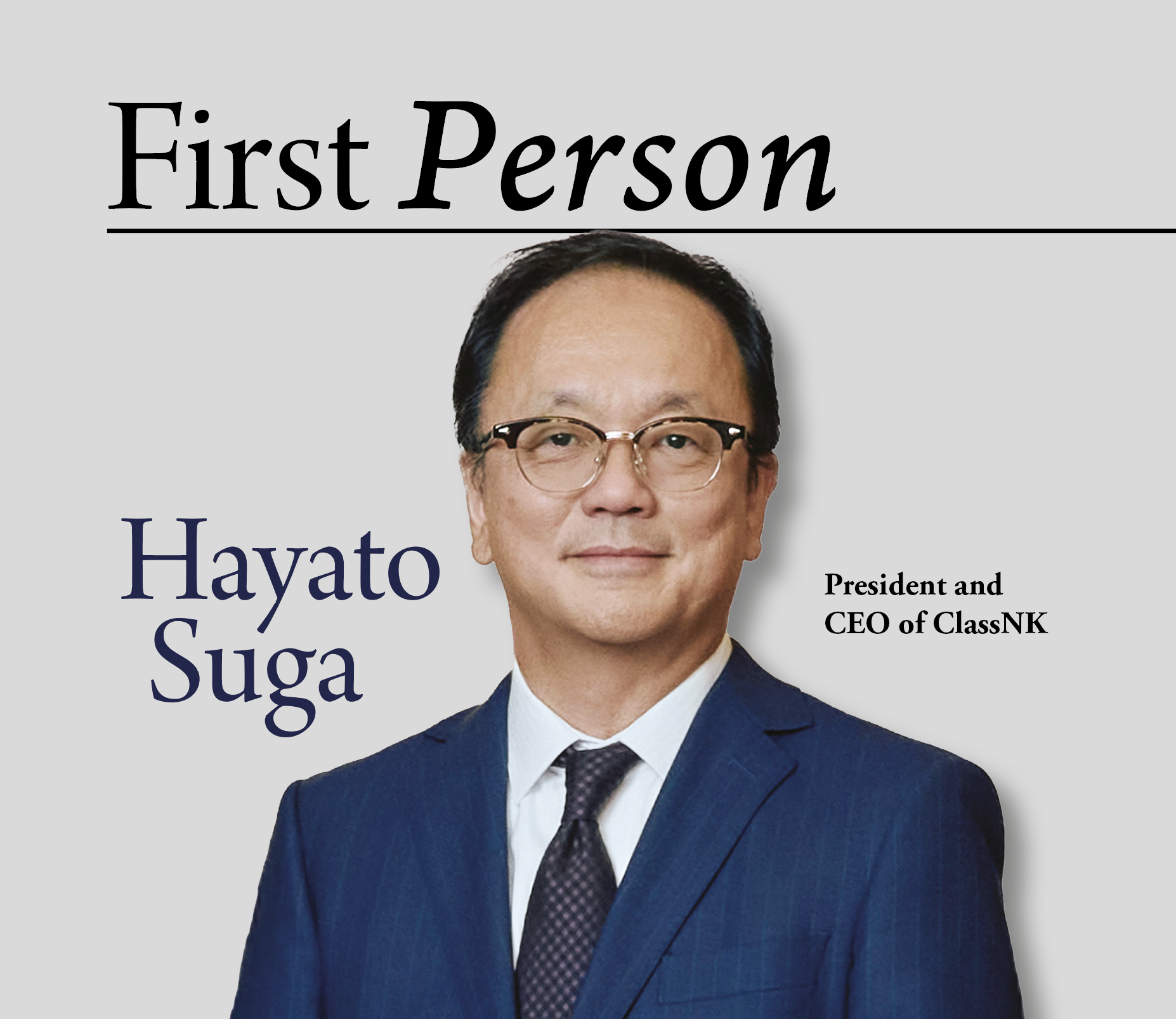
For classification societies, the pace of change in shipping is no longer theoretical. New fuels, digitalisation, artificial intelligence and geopolitical risk are all colliding with the day-to-day realities of keeping ships safe, compliant and commercially viable.
For ClassNK, the response is not to chase a single answer, but to help the industry manage a transition in which several solutions will need to exist side-by-side.
The society has been active in recent months in issuing approvals in principle and class approvals for technologies such as wind-assisted propulsion systems and an ammonia-fuelled panamax bulk carrier. These developments underline the continuing importance of technical progress, even after the postponement of the IMO Net-Zero Framework.
While the delay has added uncertainty, ClassNK does not believe the basic direction of travel has changed. The industry remains committed to decarbonisation under the IMO’s greenhouse gas reduction strategy, but there is now an even greater need for clarity, international consensus and practical guidance.
The concern for class is that uncertainty can slow investment, delay decision-making and encourage fragmented approaches. Shipping needs a framework that is internationally unified and capable of being applied consistently across different flags, vessel types and operating profiles. Without that, owners and managers are left trying to make long-term investment decisions in a regulatory landscape that is still moving beneath their feet.
“Although the adoption of the IMO Net-Zero Framework (NZF) has been postponed, I believe its direction has not changed,” said Hayato Suga. “As the postponement has increased uncertainty around the movement toward decarbonisation, we hope that IMO will work together with Member States, build consensus among countries and relevant stakeholders, and provide guidance at an early stage on an internationally unified framework in line with the GHG Reduction Strategy. Through this, we expect the decarbonisation of international shipping to move forward.
Suga-san added: “For ClassNK, this delay has made it even more important to support the industry through a transition period where several options may exist in parallel, rather than assuming one specific fuel or one single solution.”
ClassNK’s view is that the transition must remain realistic and flexible. It is unlikely that a single fuel will dominate all ship types or trades in the near future. Biofuels and LNG may have a role to play in the short term. Lower-emission blue fuels may then support the next stage of the transition before the wider availability of green fuels. But fuel choices will depend not only on emissions performance, but also on geopolitics, technology maturity, investment capacity, infrastructure, trading patterns and the condition of existing fleets.
That creates a complex decision-making environment for shipowners and managers. A deep-sea bulk carrier, a tanker, a coastal vessel and a containership operating on a fixed route may each require different answers. The role of class is to help owners assess those options against safety, technical feasibility, compliance and economic viability.
In the meantime, ClassNK sees strong value in energy-saving technologies that can be introduced more readily. Wind-assisted propulsion, low-friction coatings and voyage optimisation systems may not represent the full answer to shipping’s carbon challenge, but they are practical measures that can deliver benefits now. As uncertainty around future regulation and fuel availability gradually reduces, more fundamental measures such as alternative fuels and onboard carbon capture are expected to move forward at greater scale.
“We will continue to support industry stakeholders in making appropriate decisions based on safety, technical feasibility, regulatory compliance, and economic viability, including through the issuance of AiPs and the provision of information, and contribute to a realistic transition,” he said.
This practical approach reflects a wider shift inside ClassNK itself. The society’s current agenda is focused not only on the future of shipping, but also on the speed and reliability with which it can respond to industry needs.
As a certification body, ClassNK sees its first responsibility as providing reliable services. But in a fast-changing market, reliability alone is not enough. Timing matters. A service that arrives too late may lose much of its value. The organisation is therefore placing greater emphasis on execution, decision-making speed and practical responsiveness.
To support this, ClassNK has been adjusting its internal structure. Authority is being delegated more widely through an increased number of corporate officers, while planning and business functions are being reorganised to improve the journey from identifying customer needs to implementing concrete measures. The aim is to make the organisation more agile without compromising the trust and technical rigour on which classification depends.
Recognition is another priority. As environmental regulation expands and digitalisation increases transparency, the number of stakeholders with an interest in classification and certification is growing. Class is no longer speaking only to owners, managers, yards and flag administrations. Charterers, financiers, insurers, regulators, technology providers and wider society are increasingly focused on how ships are assessed, certified and monitored.
For ClassNK, this creates both a challenge and an opportunity. According to the President & CEO, the society does not see its future in moving into entirely unrelated fields, but rather in applying the capabilities of classification to new needs. By doing so, it aims to build recognition and trust among a broader group of stakeholders while remaining grounded in its core role.
That core role is also central to what the IMO expects from classification societies. As Recognised Organisations, class societies carry out surveys, audits and certification on behalf of flag states. Their responsibility is not simply to understand international rules, but to translate those rules into safe and effective implementation on board actual ships.
This becomes especially important in areas such as alternative fuels and digitalisation, where regulation is developing quickly and the practical implications can be significant. Rules must work not only in committee rooms, but also in engine rooms, shipyards, management offices and on the bridge. Class societies bring certification experience, technical expertise, independence and global networks to that process.
ClassNK sees itself as a bridge between regulation and implementation. The experience gained through surveys, approvals and certification also feeds back into future rule development, helping regulators understand what works in practice and where further clarification may be needed.
“In particular, in areas such as alternative fuels and digitalisation, the certification experience, practical knowledge, global networks, independence, and technical expertise of classification societies become increasingly important. ClassNK would like to make use of these strengths and continue to play a role in connecting regulations with practical implementation in the field.
“Also, through these activities, we will gain experience and knowledge. We believe this will naturally lead to feedback and support for rule development,” he said.
At the same time, the external risk environment facing shipping has become more volatile. Geopolitical disruption, supply chain instability and the growth of the shadow fleet have all increased the pressure on owners, managers and class societies. In such circumstances, ClassNK says the highest priority must remain safety, while ensuring that essential services continue even during emergencies.
The recent situation in the Persian Gulf provided an example of this approach. ClassNK supported owners and operators through flexible responses, including prior coordination with flag state governments and the use of remote surveys where appropriate. The aim was to maintain support for on-site operations as far as possible while adapting to the realities of the risk environment.
This ability to continue operating under pressure is becoming increasingly important. Shipping cannot afford for technical assurance to stop when disruption occurs. Class must be able to respond quickly, maintain standards and support the safe movement of maritime trade even when normal operating conditions are challenged.
“We will continue to contribute to the safety and stability of maritime transport by responding to the changing risk environment and continuously providing reliable services,” said Suga-san.
Digitalisation and artificial intelligence will add another layer to this transformation. ClassNK believes AI will play an increasingly important role in shipping, not only by improving efficiency but by reshaping services, decision-making and potentially business models.
The opportunities are significant. AI could be used to predict risk, assess ship safety, optimise environmental performance and support more sophisticated decision-making across fleets. For ship managers, this could mean better insight into vessel condition, operational performance, maintenance planning and regulatory compliance.
But ClassNK is also alert to the concerns. As AI systems become more advanced, their decision-making processes can become difficult to explain. Responsibility may become blurred if a recommendation or assessment is generated by technology that users do not fully understand. For a sector built around safety, accountability and trust, that is a serious issue.
ClassNK’s Digital Solutions Division, established in April this year, is intended to help the organisation move more quickly and confidently in this area. Its role is to promote the use of digital technologies, including AI, while addressing governance issues such as reliability, transparency and responsibility across the organisation.
Behind these strategic priorities sits a personal story of long commitment to the maritime industry. Having joined ClassNK in 1986, during a severe downturn in shipping, its senior leadership reflects a generation that chose maritime not because it was easy, but because it offered the chance to contribute to a wider industry. While many graduates at the time looked to sectors such as automotive, he deliberately chose the maritime sector. Rather than pursuing a narrowly specialised field, he wanted to contribute to the broader maritime industry. He was attracted to a career in classification, which offered the opportunity to gain comprehensive experience across the industry while contributing to society.
That sense of service still shapes the management philosophy today. The aim is to respect the initiative of individual staff while building an organisation that can act quickly and steadily. Individual performance matters, but so too do teamwork, contribution to the organisation and the development of long-term expertise.
For ClassNK, the challenge is to combine agility with continuity. Staff need the confidence to build careers, deepen experience and contribute to trusted services over the long term. Welfare, loyalty and organisational trust are therefore not soft issues; they are part of the foundation that allows a classification society to operate effectively.
“As for the balance between work and leisure, I travel frequently for work and do not have much free time, but I try to find opportunities to take short, intensive trips whenever I can. Visiting different places allows me to experience an atmosphere different from my daily life and refresh my mind. Even within limited time, actually going to a destination, seeing it, and experiencing it firsthand is a wonderful experience, and I also enjoy the sense of achievement it gives me.
“Regarding management, I believe it is important to respect the initiative of each staff member, while building an organisation that can act quickly and steadily. To achieve this, it is important to have a system that properly evaluates not only individual results, but also teamwork and contribution to the organisation. It is also important to create an employment environment where staff can work with peace of mind over the long term, and build their experience and expertise. In addition, welfare measures that increase trust in the organisation and loyalty are also important.
“By strengthening this foundation, I would like to manage the organisation in a way that allows each staff member to fully demonstrate their abilities, and enables ClassNK to continue providing services trusted by society and customers,” he concluded.