
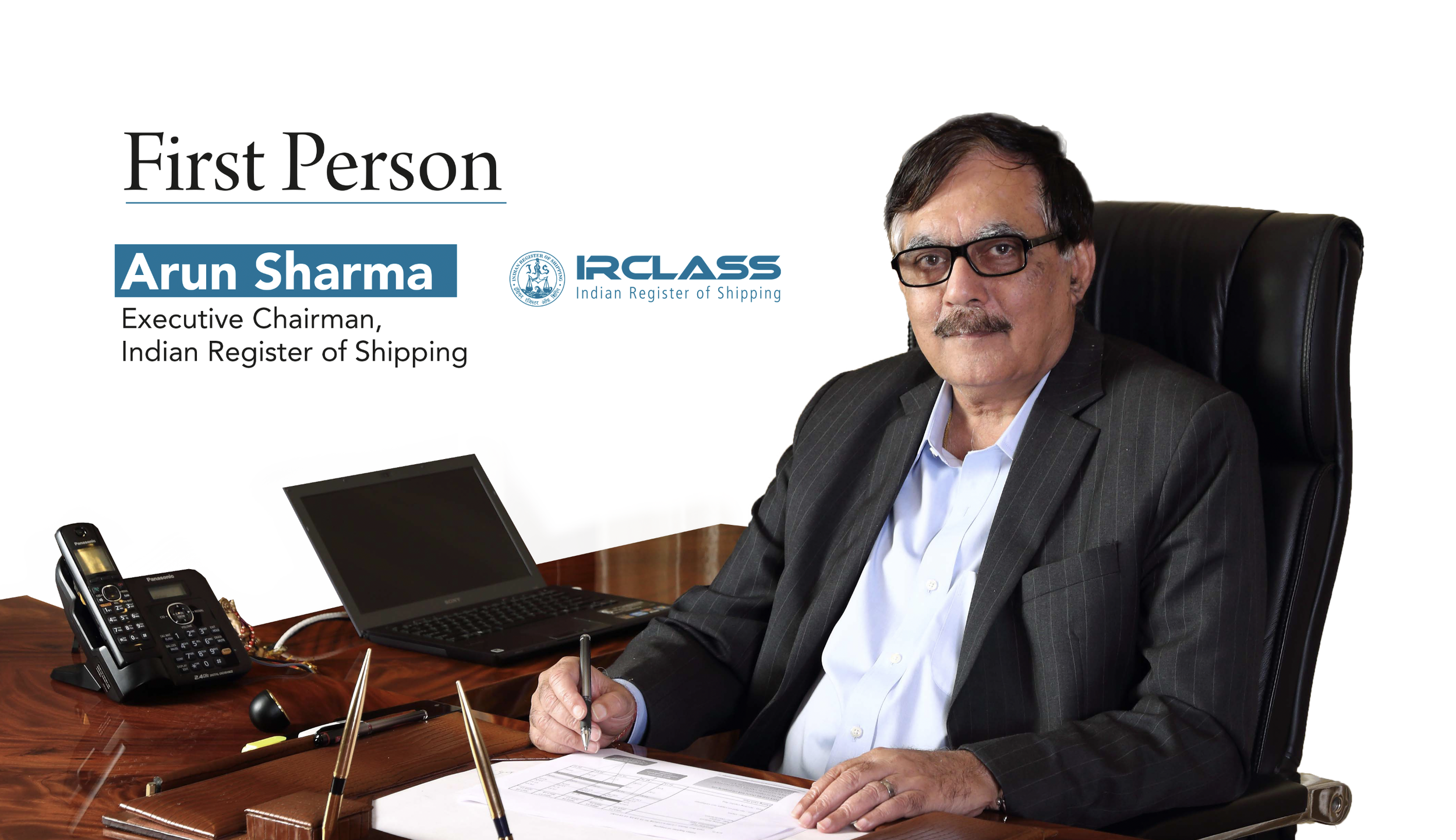
With Indian shipping and shipbuilding enjoying something of a renaissance under the Ministry of Ports, Shipping & Waterways’ ‘Maritime India Vision 2030’ and ‘Sagarmala’ programmes, no-one is more gratified – or has played a more influential role – than Mr. Arun Sharma, longtime head of Indian Register of Shipping (IRS).
Currently Executive Chairman of IRS (aka ‘IRClass’), Mr. Sharma joined the company after an early career which saw him graduate from marine engineering college in Calcutta/Kolkata and then spend nine years at sea, the last four as Chief Engineer. He then came ashore to join the Shipping Corporation of India (SCI), before moving on to hold various senior management roles with Varun Shipping Company, Great Eastern Shipping and India Steamship.
“In the early 1970s, when I was first choosing my career, shipping in India was like a rising star,” Mr. Sharma recalls in an exclusive interview with SMI. “It was an upcoming industry, with SCI receiving new ships all the time, and had a lot of glamour attached, as well as being lucrative and offering opportunities to travel.
“I have never regretted moving into this industry, where I’ve seen a lot and gained a lot of knowledge,” he continues. “It has also been a very ‘hands-on’ profession, which is something I’ve enjoyed.”
Mr. Sharma joined IRS as Chairman and Managing Director in February 2012 and has since overseen a subsequent step change in Indian maritime technology. With five subsidiary companies specialising in different areas of technology, IRS has been listed among the Top 10 Classification Societies by Lloyd’s List every year since 2013.
IRS had joined the International Association of Classification Societies (IACS) as a full member in 2010 and quickly progressed from being an IACS member to an active contributor to leading the Association. Mr. Sharma himself served as IACS Chairman from 1 July 2019 to 30 June 2020, his tenure -and IACS’ policies of the time such as its digitalisation drive - being particularly appreciated by international maritime community, coinciding as they did with the turbulent times around the onset of the pandemic. Mr Sharma has also served Head of the IACS Small Group on Quality Policy (SG/QP) and is currently Chair of its Sub Committee on Quality Policy (SCQP).
Earlier in his career, Mr Sharma sat on the board of the Indian National Shipowners’ Association and on the Asia Committees of LR, ABS and DNV, and more recently he has won no fewer than three Lifetime Achievement Awards. In April 2021 he was bestowed India’s highest maritime recognition, the ‘Varuna Award’, and since Spring 2025 he has been a member of India’s National Shipping Board.
After such an illustrious maritime career spanning different sectors of the industry, how does Mr Sharma feel shipping as a profession has changed over the last 50 years?
“Unfortunately, the number of people who want to go to sea has lessened since the time I started,” he begins, “and seafarer training has not moved on the way it should have done. With rapidly evolving technology, training hasn’t really kept pace. Education for seafaring people needs to be entirely revamped.
“Secondly, when I went to sea, compensation was substantially different to what you had ashore, and leave periods were very generous. So the lifestyle was good, and the social life at sea was better too. If you were to give today’s seafarers better conditions, I’m sure some of the glamour could return.”
And what are the IRS Chairman’s views about India as a rising maritime force in recent years?
“I always felt that the shipping sector wasn’t given the attention it deserved and the importance it should have had. But if you look at the current government, I think they realise there’s a huge gap between where they should have been and where they are. And to be very candid, if you look at the entire maritime industries, the opportunities now are huge. State-owned companies have been given a huge budget to buy and build ships over the next four to five years, and I think it is very well deserved.”
And how is India’s shipbuilding industry rising to the challenge?
“One could always do reasonably good repairs and small shipbuilding in India, so I think somewhere down the road, people just forgot to look at the sector. I think this government has realised that and is taking it very seriously and it will be given the kind of attention’ it deserves.”
Revitalised fleet
IRS has been playing a pivotal role in the country’s maritime renaissance, upscaling its classed tonnage dramatically over the last 10 years. The fleet has more than doubled in size from around 10 million GT to over 20 million GT today – a number that would be “more like 30 million GT if it wasn’t for the effect of geopolitics and sanctions,” Mr Sharma adds. More significantly still, the ratio of domestic/foreign owners has completely altered, from “what used to be 90/10. to more like 40-50/50-60 today,” he says.
“IRS class has been recognised by foreign owners,” states Mr. Sharma - as evidenced by the fact that during 2025, leading containership owners CMA CGM (4 vessels) and Maersk (two vessels) both had vessels single-classed with IRS, with MSC vessels expected to follow suit in 2026.
And then there are all the technical upskilling efforts that IRS has been involved in, not only of seafarers but also of shipyard workers, such as the initiatives announced at India Maritime Week late last year, including an MoU signed with Cochin Shipyard and DP World.
So what does Mr. Sharma consider his greatest achievements have been at IRS?
“Besides increasing tonnage at IRS as mentioned, more important still has been an increase in quality that we’ve been very focused on,” he replies, suggesting that may be why he was chosen to head up various IACS quality initiatives.
“I’ve also placed a lot of emphasis at IRS on leadership qualities and empowering people within the right teams so that they can apply themselves qualitatively and quantitively in the shortest possible time,’ he adds.
Finally, are there any words of advice that the IRS Executive Chairman would like to share with fellow maritime leaders.
“I would say that you want to concentrate on developing leadership within an organisation, people who can take over in five to seven years’ time,” replies Mr. Sharma. “You should seek a situation where your numbers two and three are such that you begin to feel redundant and are happy that people don’t need to contact you for a few days at a time.
“And I believe encouraging a good working environment is important too,” he concludes. “People should want to come to work. They say in England that ‘children walk to school but run home’. Wouldn’t it be great if, in the workplace, that were reversed!”