
Middle East conflict: Strait of Hormuz transits back to 90% below pre-conflict levels
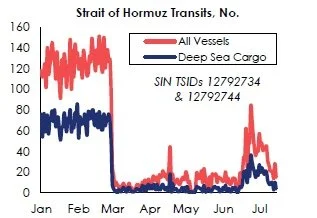
In a latest briefing issued yesterday (20 July), Clarkson Research reports that In tonnage terms, transits have now fallen to >95% below ‘pre-conflict’ levels in recent days. An average of 12 crossings per day has taken place over the past 5 days, compared to 10 in March-May,45 in the first week of July, and 125 pre-conflict.
The flow of energy leaving the Gulf continues to ease back, with an average of ~1.5m bpd of crude passing through Hormuz over the past week (down from 10m bpd in early July and 15m bpd pre-conflict). No ‘mainstream’ VLGCs have left the Gulf in 10 days while no laden Qatari LNG carriers appear to have transited the Strait in nearly 2 weeks.
The share of vessels passing ‘visibly’ via the Oman route remains limited, accounting for 2% of all transits over the past 5 days, down from a 22% share in early July.
Last week saw the highest level of vessel attacks (5 in total) in the Middle East over the past 2 months, with further incidents reported over the past 24 hours.
The number of vessels waiting off Oman remains stable at elevated levels for now; ~385 vessels currently waiting off Oman, down 2% w-o-w but still 25% above start-June levels.
Around 850 internationally trading vessels are currently in the Middle East Gulf, including 6% of VLCC, 3% of product tanker, 3% of LNG carrier capacity.
For now, ‘energy’ shipping markets remain elevated with alternatives, distance and disruption mitigating loss of volume.
VLCC earnings are $128,000/day (+32% vs start-June), while Suezmax / Aframax earnings are up 63% / 68% over the same period to $148,000/day / $109,000/day though product tanker markets have been steadier (MR Clean: $25,000/day).
Supportive arbitrage dynamics have again developed, boosting gas carrier rates, with VLGCs re-bounding to $145,000/day and LNG rates steady at >2x pre-conflict levels.