
Freight ferry Menawethan arrives in Isles of Scilly
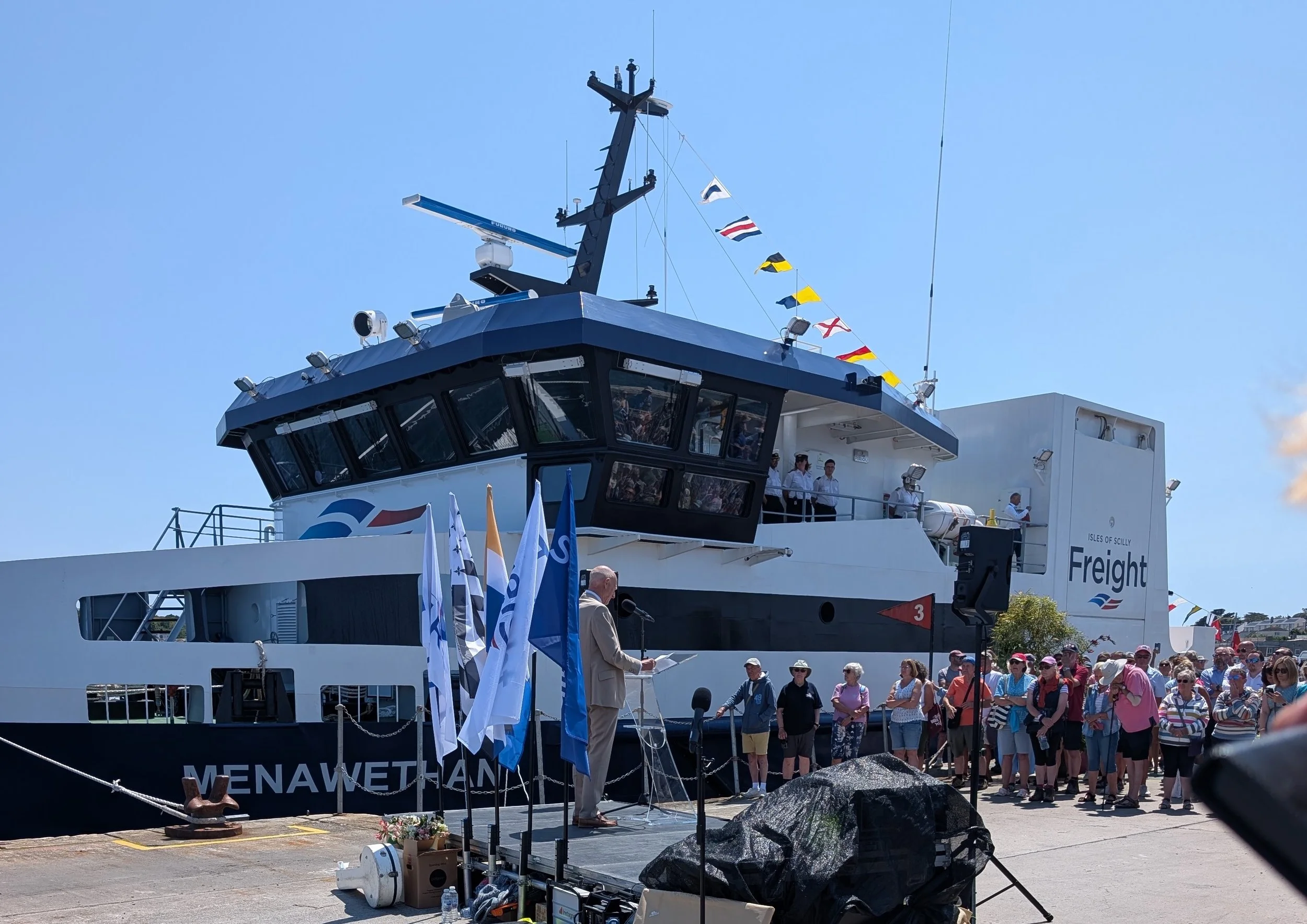
The naming of a 45-metre-long, 984 grt freight vessel in a small island harbour might not sound so remarkable – but for businesses and residents of the Isles of Scilly, 34 miles off England’s most south-westerly point, the arrival of the Menawethan marks a major turning point.
The vessel officially entered service this week and forms part of the Isles of Scilly Steamship Group’s £40m fleet renewal programme. A new passenger vessel, Scillonian IV, has just started sea trials in Vietnam and is due to arrive in the UK early in 2027.
Both have been purpose built at Piriou’s shipyard in Ho Chi Minh City. Steamship Group board member Sam Hicks said: “Menawathen, inside and out – what a remarkable ship she is. She is the islands’ first purpose-built freight ship, with greater scale and capacity than we have ever known before. When the original specification was developed, it was the Scilly community that guided that process through consultation, and the message was clear – reliability and capacity above all else. We saw last winter what happens when that falls short.”
Islanders have waited years to see modernisation of the fleet on the lifeline service between Penzance and St Mary’s. Compared with the freight vessel Gry Maritha, which has served the islands since 1989, Menawathen – the name derived from one of the 12 uninhabited Eastern Isles that form part of the Scillies - provides 50 tonnes more cargo capacity, for a total 207 tonnes capacity, and a 20 per cent increase in chilled and frozen capacity. There is also provision for 12 passengers.
Scillonian III was built at Appledore Shipbuilders in North Devon and entered service in 1977. Scillonian IV will carry up to 600 passengers, a 24 per cent increase. More importantly for many passengers who have endured stomach-lurching voyages out into the Atlantic, the new passenger vessel will feature improved comfort thanks to hull form, fin stabilisers and hull vane.
In addition, Scillonian IV has been built with alternative fuel capabilities and an energy storage system.