
US-Iran deal could boost fertilizer shipments after 11% drop
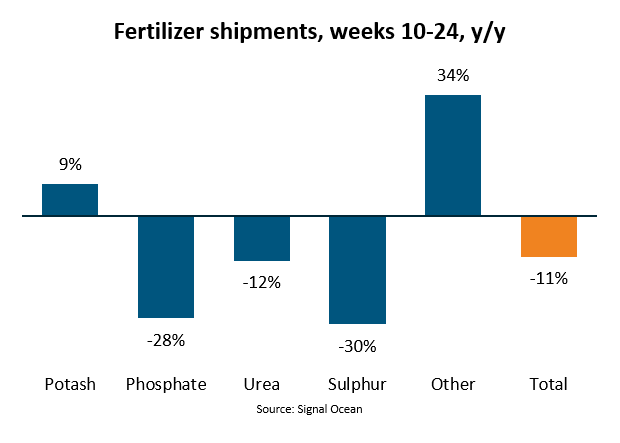
"Global fertilizer shipments have fallen 11% y/y since the start of the Iran war. The closure of the Strait of Hormuz has restricted fertilizer exports from the Persian Gulf, tightening the global supply and increasing prices. The ceasefire agreement between the US and Iran could lead to a rebound in shipments,” says Filipe Gouveia, Shipping Analysis Manager at BIMCO.
Under normal conditions, 16% of global fertilizer shipments come from the Persian Gulf and pass through the Strait of Hormuz. The closure of the strait has significantly disrupted cargo volumes. Phosphates, urea and sulphur have been particularly affected, with shipments falling 28%, 12% and 30% y/y since the start of the war. This has supported higher fertiliser prices although the price of urea has partly eased recently as China issued new export quotas.
The production of phosphates and urea has been further disrupted by the tighter supply and higher cost of sulphur and natural gas. Sulphur is used to produce phosphates and exporters such as Morocco and China rely on imported sulphur. Natural gas is used to produce urea, and global LNG shipments have dropped 7% y/y since the start of the war.
“The supramax and handysize segments have been impacted the most by the loss of fertilizer cargoes, with volumes falling 13% and 7% y/y. Fertilizers typically account for only around 5% of total dry bulk demand, but they account for 11% of supramax demand and 13% of handysize demand. While this has been a negative for the supramax and handysize segments, rates have increased overall, supported by higher grain shipments and stronger market conditions for the panamax and capesize segments,” says Gouveia.
The ceasefire deal between the US and Iran aims to end hostilities and give negotiators 60 days to negotiate a permanent truce. Under the deal, the US commits to end its naval blockade within 30 days, while Iran will make arrangements using its best efforts for the safe passage of commercial ships with no charge for 60 days from the Perian Gulf to the Sea of Oman and vice versa.
Upon the reopening of the strait, fertilizer exports are expected to rise, driven by pent-up demand. At least 30 ships are already laden with fertilizer cargoes in the Persian Gulf and 70 ships in ballast could load more.
“In the medium term, fertilizer production and exports in the Persian Gulf could mostly recover since direct damage to production facilities has been limited. However, exports from Qatar and the UAE could remain below pre-war levels since they have sustained damage to gas fields and refineries. In Qatar, Ras Laffan is expected to operate at 50-80% capacity during the next months, while in the UAE the Habshan complex is projected to operate below 80% capacity until the end of this year,” says Gouveia.