
BAR Technologies validates six-month carbon payback for WindWings
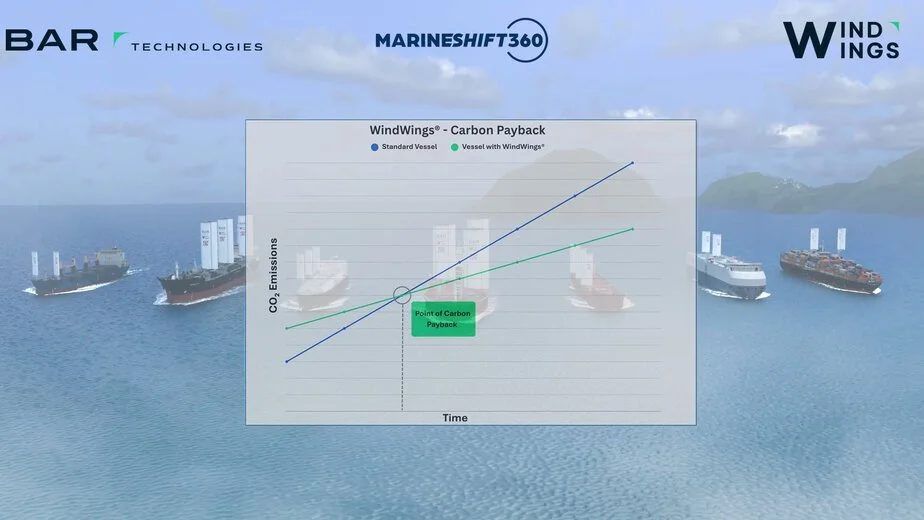
MarineShift360 has announced results from its recently concluded Impact Accelerator programme, including the outcomes of BAR Technologies' lifecycle assessment of its pioneering WindWings® system. The study confirms that WindWings® achieves a carbon payback in under six months, setting a new benchmark for transparency and lifecycle performance in the maritime sector.
BAR Technologies completed the 10-month Impact Accelerator programme, which applies advanced lifecycle assessment (LCA) to drive sustainability in marine design and supply chains.
The analysis demonstrates that the WindWings® system, which is already reducing fuel consumption by an average of 1.5 tonnes per wing per day, hence cutting CO2 emissions by 4.7 tonnes daily on global shipping routes, offsets its embedded carbon emissions in operational use in less than half a year.
This breakthrough challenges long-held industry assumptions about the carbon cost of maritime innovation. By quantifying the true environmental return on investment, BAR Technologies is providing shipowners, regulators, and investors with verified data to support rapid decarbonisation.
"This is a landmark moment for commercial wind propulsion," said John Cooper, CEO of BAR Technologies. "To demonstrate a sub-six-month carbon payback shows that WindWings® is not only delivering immediate environmental benefit but is a commercially ready solution that meets the industry's urgent decarbonisation needs."
"Seeing the payback come out in months has validated our design approach," said Will Hopes, Simulation and Performance Engineer at BAR Technologies. "WindWings® are designed to decarbonise shipping as quickly as possible, and the study shows that this is what they are doing. LCA is a core part of every design review, not a separate consideration."
"These results show what is possible when organisations commit to fully understanding their impact," said Ollie Taylor, Director of Marine Futures. "LCA gives leaders the data to make better decisions and the confidence to scale those decisions across fleets, supply chains and product lines. As a first year, these results are incredibly encouraging and show what the Impact Accelerator was created to do, which is to catalyse change across our industry."
The LCA, conducted in line with ISO 14044 standards, revealed that metalwork contributes the largest share of embedded emissions (44%), prompting BAR Technologies to pivot procurement towards recycled-content DH32 steel produced via Electric Arc Furnace processes. Additional carbon reductions are being achieved by increasing tooling utilisation and revising composite layups.
"This wasn't just a validation exercise," added Cooper. "It enhanced engineering reviews, procurement decisions, and customer conversations. We have embedded carbon literacy across every function, because sustainable performance must be measurable, verifiable, and repeatable."