
Tight gas supply caused by Strait of Hormuz closure drives sharp rise in coal shipments
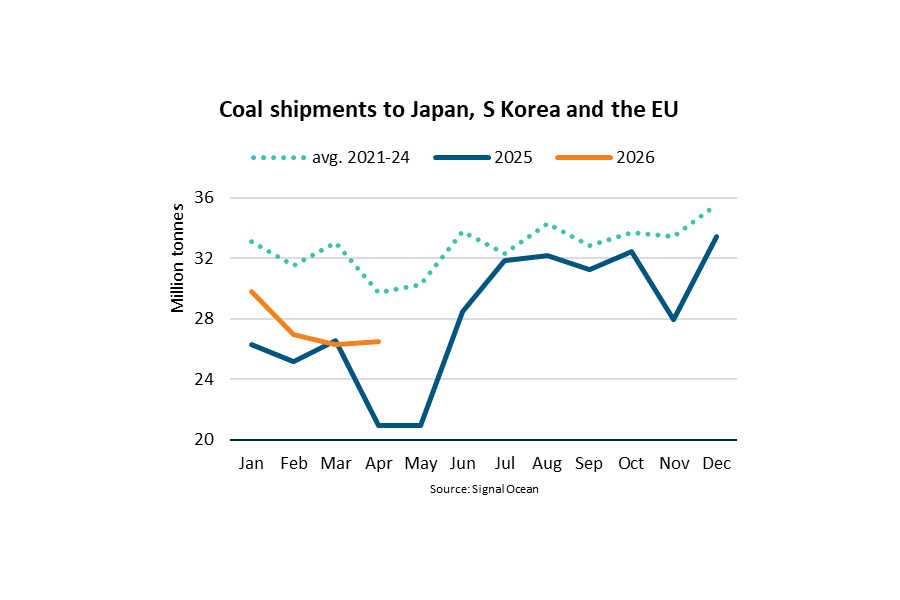
"In April 2026, coal shipments to Japan, South Korea and the EU jumped 27% year on year (y/y) as these countries seek alternative energy supplies to gas to meet their electricity demand. The closure of the Strait of Hormuz has disrupted LNG shipments out of the Persian Gulf and has contributed to an 8% y/y drop in global seaborne LNG shipments in April,” says Filipe Gouveia, Shipping Analysis Manager at BIMCO.
Coal shipments to Japan, South Korea and the EU typically slow down in April and May. This is tied to a seasonal decrease in electricity generation in Japan and South Korea due to lower demand for heating. However, this year shipments have increased 1% m/m in April, even as demand from heating fell.
The three markets have been gradually declining in importance for coal shipments as decarbonisation efforts have reduced the dependence on coal. They still account for around 25% of global coal cargo volumes and 31% of global tonne mile demand, however. On the other hand, shipments to India and China have increased.
“The rise in coal shipments to the EU, Japan and Korea have contributed to an 8% y/y increase in global tonne mile demand for coal in April 2026. Although sailing distances to these countries are on average 7% shorter than the global dry bulk average, they are still 23% longer than the global average for coal. The increase in ship demand is supporting freight rates, especially for the panamax and capesize segments,” says Gouveia.
Panamax is the main segment used to transport coal to the three markets, accounting for 58% of volumes, while capesizes transport an additional 31%. Supramax ships only transport 7%, 13 pp less than the global average, due to comparatively fewer shipments from Indonesia which relies on smaller ships. Overall, out of the coal shipments going to Japan, Korea and the EU, 46% come from Australia, 17% from Indonesia and another 17% from North America.
If the Strait of Hormuz remains closed, gas to coal switching in advanced economies, such as these three, is expected to drive growth in coal shipments in the short to medium term. Under this scenario, BIMCO currently forecasts global coal shipments to grow up to 1% in 2026 and 0.5-1.5% in 2027, 1 percentage point and 3 percentage points higher than if the strait reopens imminently.
“In the long term, we expect coal shipments to the three economies to gradually decrease, regardless of transit conditions through the Strait of Hormuz,” says Gouveia. “Electricity generation capacity from renewables is expected to continue to grow, and the recent spike in energy prices could accelerate this transition. Although some countries have extended the phase out of their coal power plants, these are expected to remain less competitive than renewables, limiting this measure’s impact.”