
Environmental NGOs welcome progress on IMO’s Net Zero Framework but warn against any further delay
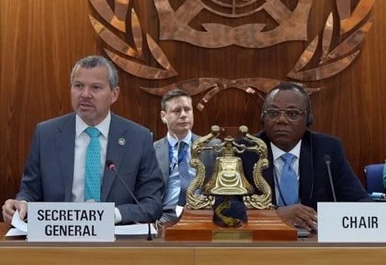
As last week’s meeting of the IMO’s Marine Environment Protection Committee (MEPC 84) closed, the Clean Shipping Coalition welcomed support from the majority of member states for the IMO’s Net-Zero Framework (NZF) despite pressure from US, Saudi Arabia, UAE, Panama, Liberia, and other petrostates, but called out the threat of further delays to adoption, which is now scheduled for early December.
The NZF will be discussed at two IMO intercessional meetings, one in September and another immediately prior to December’s MEPC 85, which will itself immediately precede a resumed Extraordinary Session 2, during which the NZF is scheduled for adoption.
“Most IMO member states have demonstrated support for the Net-Zero Framework, with many calling for its urgent adoption”, said Delaine McCullough, President of the Clean Shipping Coalition and Ocean Conservancy’s Shipping Program Director. “Clearly, the NZF must be adopted as soon as possible, without interference from those who would seek to undermine or slow the process. Any further delay to the NZF is unacceptable - it already represents years of negotiation and consensus - the IMO has no other option capable of meeting goals of its own GHG Strategy or attracting wider support.”
The IMO’s Net-Zero Framework is aimed at reducing greenhouse gas (GHG) emissions from ships, in line with the 2023 GHG Strategy. The NZF includes a global fuel standard (GFS), requiring ships “to gradually reduce how polluting its ship fuel can be (i.e. how much greenhouse gas is emitted for each unit of energy used, across a fuel’s life cycle)”. It also includes a mechanism for setting prices on the GHGs ships emit, to encourage the shipping industry to lower emissions as per the global fuel standard.
“We welcome the news that the Net-Zero Framework remains on the table. It’s a critical foundation for decarbonising shipping”, said Anaïs Rios, Senior Shipping Policy Officer, Seas At Risk. “But what started off as a legitimate framework, with a carbon pricing at its core for a chance at a just transition, has been weakened along the way. Recent events have exposed the truth. Our dependence on fossil fuels is not just a climate risk, it’s an economic and geopolitical liability. However, solutions already exist: Wind propulsion can cut emissions today and ease the reliance on scarce and expensive new fuels. Shipping must play its fair share, and countries must do the same.”
“It is a relief that the Net Zero Framework survived, but we cannot let delays become the new norm. Now is not the time for setting up compromises that water down the deal or to kick the can down the road”, said Felix Klann, Shipping Policy Officer at Transport & Environment. "At the same time, the IMO cannot lose track of its technical work. It will determine whether future fuels and technologies are truly sustainable just shift emissions away from ship to shore.”
"The USA and their allied petrostates weren't successful in stopping climate negotiations at the IMO,” says Lukas Leppert, Policy Officer at NABU. “However, they obstruct final adoption of necessary and agreed measures. The IMO must adopt the Net-Zero Framework by 2026. Neither the industry nor our planet can afford to bear the consequences of further delays: rising costs of an already costly transformation, and the escalating threats of global warming."