

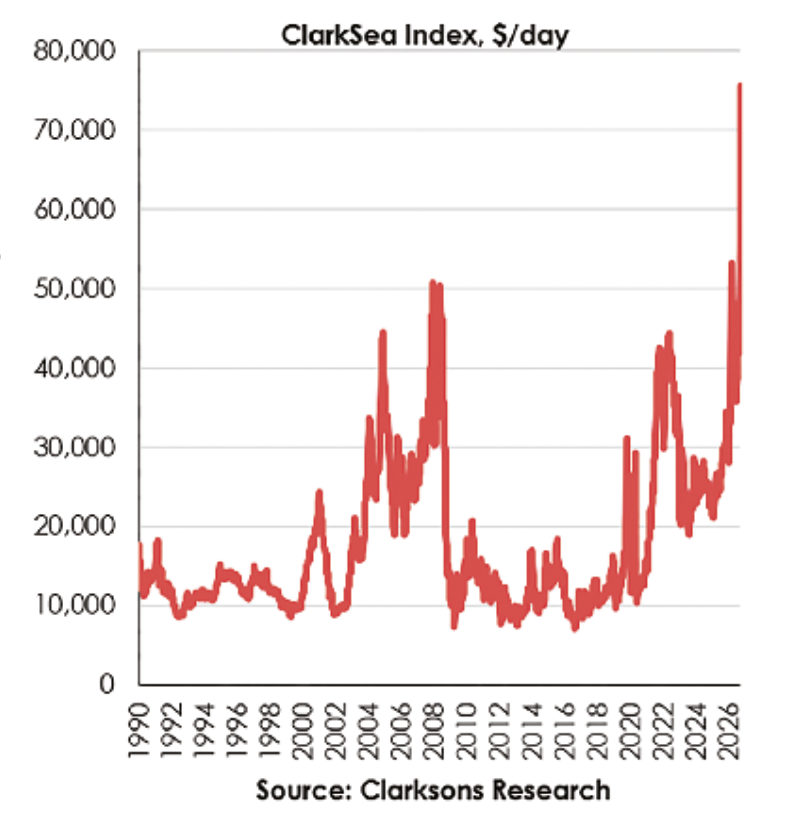
Clarksons’ cross-segment shipping market barometer the ClarkSea Index hit an all-time high in Q3 (of $46,384/day), driven by the exceptionally high, disruption-driven rate environments in crude and LPG and supported by strong market conditions across container, car carrier and bulkers.
The record quarterly level topped the $44,222/day of Q2-2008 and is twice the 10-year trend. It also included the highest ever individual week ($66,000/day), reported Steve Gordon, Global Head of Clarksons Research.
Developments in the Middle East have been the principal driver, with shipping providing the logistical flexibility needed to move significantly increased volumes of oil ‘to market’. The July-to-September quarter ended with an estimated 12m bpd of crude (pre-conflict 15m bpd, lows of <2m bpd in Q2 2026) transiting Hormuz, mainly by a ‘shuttling’ fleet from within the Middle East Gulf to the Gulf of Oman where oil is then transferred (via STS operations that take several days) to additional tankers for onward delivery to Asian markets.
There have also been changes in logistics at Yanbu, Clarksons reported, with flows to Asia largely re-routed to avoid the Houthi threat by using ‘shuttles’ to SUMED pipeline and then routing via Cape of Good Hope (attacks on pipeline to Yanbu now paused some of this flow) and more long-haul Brazilian exports (less US volumes).
This combination of improved volumes plus additional inefficiencies and distances pushed global VLCC spot earnings to exceptional levels averaging over $600,000/day and on occasion reaching as high as $1.6m/day in Q3; by early October, that average had risen to $805,000/day, Clarksons later added.
Demand for ships for the shuttle operations also helped S&P prices surge to all-time highs, with a 15-year-old VLCC commanding a greater price than a newbuild on account of it being able to trade immediately
Operational risk remains high, however, Clarksons pointed out with continuing vessel attacks in the Gulf, Red Sea and Black Sea. Aside from the Middle East, other disruptive geopolitical issues include tariff uncertainty and Panama Canal.
Regarding tankers, the unprecedented strength in the VLCC market [see also Analysis] filtered down into Suezmaxes, averaging a record $228,262/day in Q3, and Aframaxes, averaging $119,189/day. The product tanker market was more modest by comparison but still averaged $31,157/day for MRs and firmed to $60,000/day by quarter end.
Clarksons Research says the short-term market outlook appears very strong, boosted by exceptional crude tanker markets, and developments in the Middle East will continue to dominate the agenda. Calibrating long term future requirements for shipping demand is increasingly “tricky”, with significant complexities against the evolving geopolitical backdrop. Fleet growth and orderbook in some sectors are now more material. An “exceptional” cash position with significant opportunity but also risk [see following article] lies ahead, it concluded.