
GT Wings launches new AirWing S to reduce emissions for smaller vessels
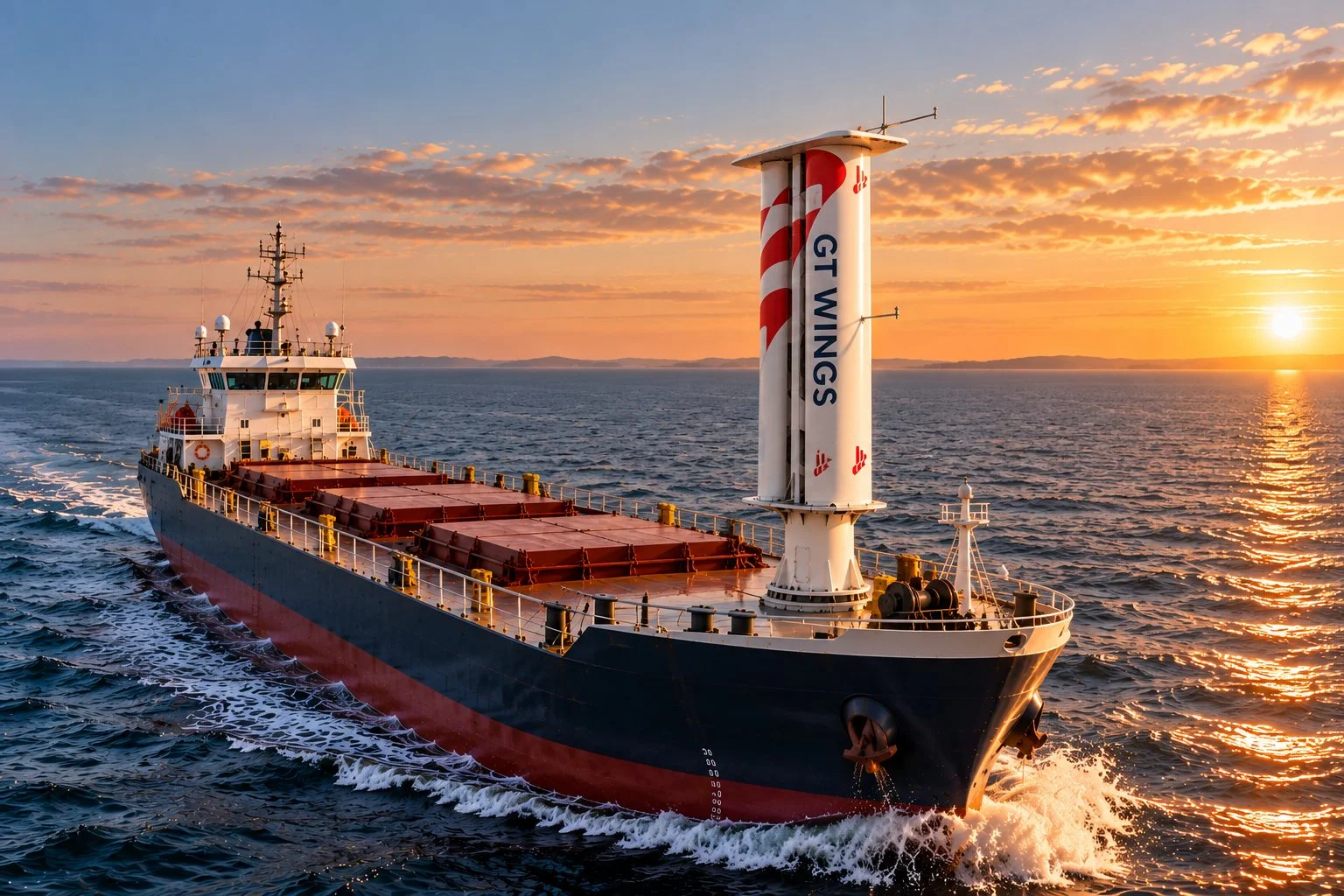
GT Wings has announced the latest addition to its wind-assisted propulsion product range, AirWing S, a new compact and lightweight Jet Sail developed to address the operational requirements of smaller commercial vessels.
The new design (render pictured) expands the AirWing product line to address a broader segment of the commercial shipping market. With a streamlined lightweight configuration, the AirWing S has been developed specifically for smaller vessels where vessel size, available deck space and weight considerations can influence the suitability of wind-assisted propulsion technology.
The launch is the next step in GT Wings’ strategy to develop a scalable family of AirWing Jet Sails, enabling the technology to be adapted to differing requirements across the global commercial fleet.
George Thompson, CEO of GT Wings, said: “The AirWing S is an important addition to our product range. We know there is significant diversity across the global fleet, and wind propulsion solutions needs to reflect the different requirements of individual vessel types. By developing a compact AirWing, specifically for smaller vessels, we can address another part of the market and make the emission reduction benefits of wind propulsion accessible to a wider range of shipowners."
GT Wings announced a strategic manufacturing partnership with Zunsion Technology in March 2026. The partnership established a framework for industrial-scale production of AirWing systems in China, combining GT Wings' wind propulsion and systems integration expertise with Zunsion's manufacturing and assembly capabilities.
Xu Jinbiao, CEO of Zunsion Technology, said: “The AirWing units now taking shape at our facility demonstrate what our partnership has already achieved, and we look forward to continuing to grow this partnership with GT Wings as its technology and product range continue to develop.”