
Wallenius vessels ‘Way Forward’ and ‘Future Way’ achieve top rating for energy efficiency
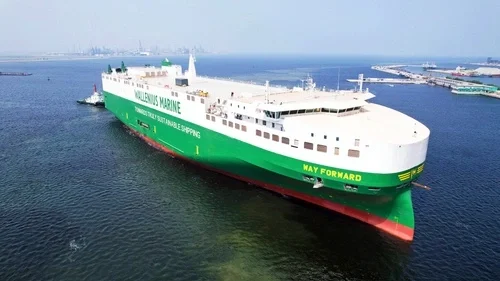
The first two vessels in the Sleipner concept – ‘Way Forward’ (pictured) and ‘Future Way’ – have, after just over a year in operation, demonstrated excellent performance, low fuel consumption and CII values far below current requirement levels. This means they emit significantly less CO2 per transported unit than the average for comparable vessels, placing them comfortably in the highest energy efficiency class (A) according to the IMO’s international classification.
The Carbon Intensity Indicator (CII) measures a vessel’s carbon emissions relative to cargo capacity and distance sailed, and is reported annually to the IMO’s Data Collection System (DCS). The thresholds for ratings A to E will become increasingly strict through 2030, making these results particularly important from a long-term performance perspective. The A‑rating of ‘Way Forward’ and ‘Future Way’ places them among the top approximately 10 percent globally within their category of Ro‑Ro Vehicle Carriers. They are already well within future emission limits and will retain their A‑rating for many years to come. “Seeing our first Sleipner vessels perform so well in real operations is highly gratifying, and it confirms that our vessel design, combined with efficient operations and a dedicated crew, together create measurable climate benefits,” says Johan Mattsson, CEO of Wallenius Marine.
Energy-saving features include:
•Hydrodynamically optimised hull for reduced water resistance and low fuel consumption
•Streamlined, low superstructure and integrated ventilation that reduce air resistance.
•Optimised, lightweight steel structure that improves performance.
•Dual‑fuel machinery for LNG/LBG and diesel/biodiesel.
•Optimised cargo configuration enabling efficient loading/unloading and minimising the need for ballast water.
• Capacity: 6,502 cars (RT43 CEU), length: 199.95 m, gross tonnage: 62,432.
‘Way Forward’ and ‘Future Way’ are the first two car carriers in the groundbreaking Sleipner concept, developed by Wallenius Marine and KNUD E. HANSEN. The concept is now also being further developed for RoRo vessels, applying the same energy-efficient principles and including the option for wind‑assisted propulsion.