
KR leads world-first pilot demonstration of autonomous mobile robot platform, aboard Hyundai Dubai
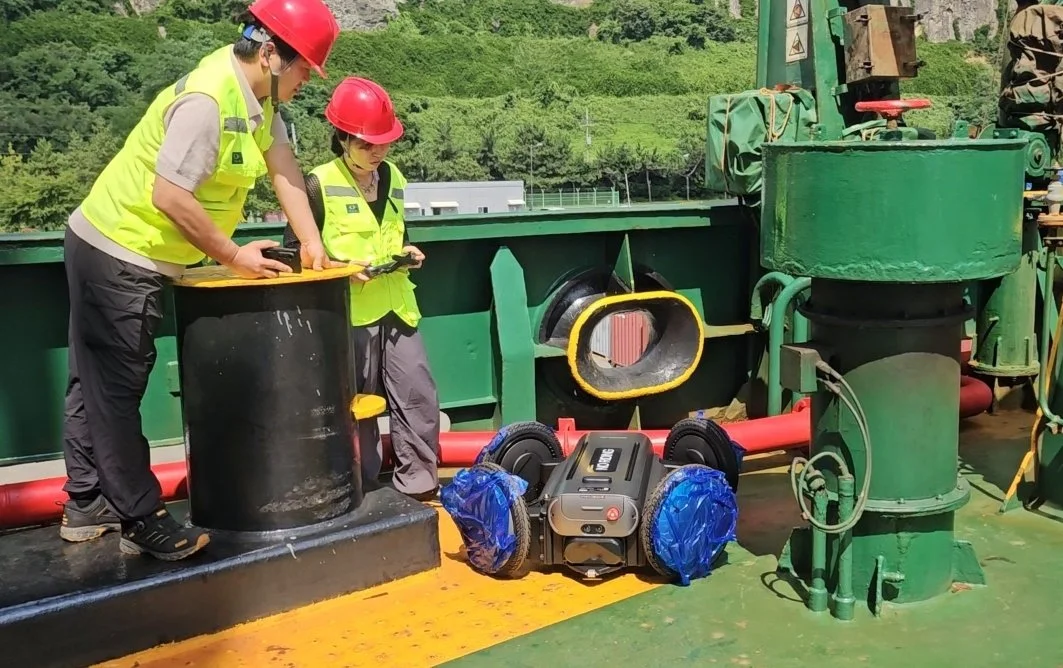
Korean Register together with Hyundai Motor and Kia, HMM, HMM Ocean Service (HOS) and Gosung Engineering, carried out the world's first onboard demonstration test of MobED (Mobile Eccentric Droid), Hyundai Motor and Kia's autonomous mobile robot platform, aboard HYUNDAI DUBAI in early July. The multipurpose vessel was berthed at the CJ Logistics Jeokhyeon Pier in Changwon, South Korea, at the time of the demonstration.
Each participating organisation contributed its respective areas of expertise to the successful demonstration. Hyundai Motor and Kia were responsible for the development of the platform and its control technology; KR reviewed relevant international regulations, safety requirements, and performance criteria for robotic systems; HMM and HOS oversaw smart vessel operations, management and remote monitoring; while Gosung Engineering handled robot system integration (SI), including top-module solutions.
MobED is a compact autonomous mobile robot platform developed by Hyundai Motor and Kia’s Robotics LAB. Its eccentric wheel-based Drive-and-Lift (DnL) module enables each of its four wheels to adjust height independently. This allows the platform to maintain a level upper surface and navigate stably across irregular or inclined terrain, even under demanding onboard conditions. MobED is equally adaptable in function, capable of being configured for a variety of roles depending on the equipment mounted on top, including delivery modules, cameras, and inspection devices.
The demonstration was conducted across two zones aboard HYUNDAI DUBAI. In the open container cargo section, MobED completed linear and curved navigation, variable-speed traversal, route learning, and fully autonomous navigation. In the vessel's passageways, low-speed navigation and route learning were carried out under manual control, reflecting the confined spatial conditions of that environment.
Through the demonstration, the participating organizations observed that open cargo areas with sufficient space are suitable for robot deployment without additional measures. Moreover, the use of robots in environments with restricted crew access, such as cargo areas carrying explosive or toxic cargo, shows potential that is worth exploring further. Passageways and engine rooms were identified as areas where supplementary equipment or purpose-scaled variants may be needed to address spatial and operational constraints.
Dr Minwoo Park, Head of the Advanced Vehicle Platform Division, Hyundai Motor and Kia, said: “This demonstration marks a meaningful step in validating autonomous mobility technology in a vessel environment, as Hyundai Motor and Kia expand the global robotics ecosystem with cross-industry partners. Hyundai Motor and Kia will accelerate this progress by building a data flywheel across their partners, driving both technological advancement and broader deployment into new sectors.”
Mr Daeheon Kim, Executive Vice President and Head of Research and Development, KR, said: “KR will continue to explore potential onboard applications with its partners, including cargo area monitoring and material transport. Through ongoing collaboration on safety and performance standards and follow-up demonstrations, KR looks forward to supporting the expansion of the smart ship ecosystems.”