
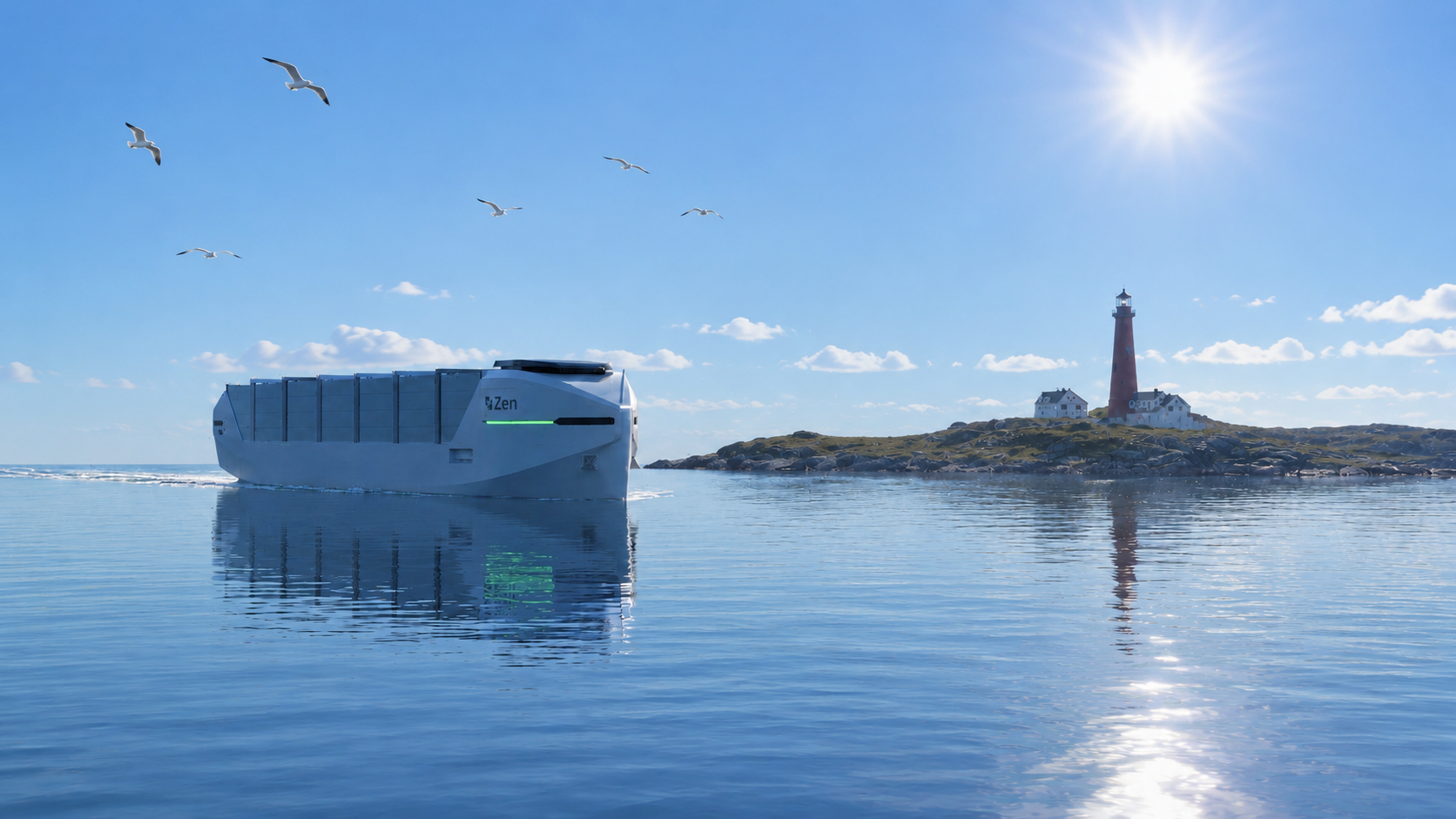
Shore power has not changed the world quite yet – to put it mildly; adoption has slowed at ports, and there are even questions over shipowners will bother to plug in in the first place. But another electrifying business model could be on the way for shipping – one that could enable the shortsea market at vanishingly low cost.
“Battery prices are dropping, capacity is increasing… we see this becoming very commercially attractive,” explained Fridtjof Camillo Eitzen, CEO and Co-Founder of Norway-based technology company Zen, at SMM last week. “So we can now design vessels from the keel up for battery powered operation.”
Zen’s is a battery with a difference. “We have designed the battery modules for water immersion, and that way we can simplify them,” he explained. Having individual cells separated by a curtain of cool water addresses many thermal-runaway concerns, as well as “… water entry, humidity, dust … we don’t have to think about that once the batteries are watertight. In the event of thermal runaway, the gas will go out and water will go in.”
Containerised and marinised in this way, the batteries could be loaded onto a vessel by crane and connected once on deck, conferring many advantages over a conventional integrated battery and shore-charging. Eitzen estimates that such a vessel with 100MWh of battery capacity could travel 500 nautical miles, the distance from Oslo to Rotterdam. “If it can do that, it can take a lot of the routes in Europe, purely on battery.”