
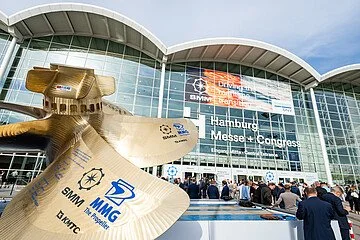
For four days, SMM 2026 focused on the key challenges facing the maritime industry – from maritime security and resilient supply chains to energy efficiency and new propulsion technologies, artificial intelligence and autonomous systems. A record attendance of more than 50,000 people from shipping companies, shipyards, suppliers, technology companies, navies and international organisations used the event to discuss investment, new technologies and partnerships.
“What we have seen over these four days is an industry with a strong determination to shape its future,” says Claus Ulrich Selbach, Vice President Exhibitions Maritime & Energy at Hamburg Messe und Congress. “Despite geopolitical and regulatory uncertainty, companies are investing, seeking solutions and building new partnerships. Across all topics, there was a clear sense that available technologies need to be deployed more quickly,”
The growing importance of maritime security was particularly evident in the new NavalHall B8. The MS&D Conference & Expo and the Naval Stage brought together international navies, defence companies, maritime suppliers and providers of dual-use technologies. The focus was on unmanned systems, sensors, cybersecurity and the protection of critical maritime infrastructure.
The protection of critical maritime infrastructure was also a central topic at the Offshore Dialogue. Moderator Dr Walter L. Kuehnlein highlighted in particular the open and lively discussion with the audience about technological and operational solutions.
While security and resilience are playing a greater role on the agenda, decarbonisation and energy efficiency remain key challenges for the industry. Against a backdrop of uncertain regulatory conditions and continuing uncertainty over the fuels of the future, attention is increasingly turning to technologies that can be deployed today to reduce fuel consumption and emissions. At the new Energy Efficiency Hub, 24 companies presented solutions across 300 square metres, ranging from wind propulsion and alternative propulsion technologies to measures for optimising existing fleets.
“The Energy Efficiency Hub is a valuable addition to SMM. What stood out to us in particular was how specific the discussions have become: shipping companies are actively looking for solutions to improve fleet efficiency and are increasingly exploring technologies such as wind propulsion that can already be deployed today,” says Ada Ak, Sales Engineer at BAR Technologies.
The Global Maritime Environmental Congress (gmec) on the Energy Efficiency Stage demonstrated that decarbonisation continues to be a major concern for the industry. In front of a capacity audience, industry representatives discussed the path towards climate-neutral shipping. The focus was on collaboration across the maritime value chain and on Green Shipping Corridors as a potential model for advancing decarbonisation across the maritime sector.
Alongside technological and security-related topics, attracting the next generation of maritime professionals remained an important focus. During the two-day Maritime Career Market, companies, universities and industry associations engaged with students, young professionals and maritime specialists.
“After four days of SMM, one thing is particularly clear to me: this industry is not standing still. Companies are investing, seeking partners and looking to deploy available technologies more quickly. Especially in the face of geopolitical and regulatory uncertainty, this determination to act is crucial. SMM brings together the players who can jointly move solutions forward,” concludes Selbach.
The next SMM will take place in Hamburg from 5 to 8 September 2028.