
European ports must diversify to survive, SMM panellists argue
Specialising themselves into a corner by becoming experts in just-in-time supply chains and economies of scale, European ports must urgently put this strategy into reverse, SMI heard at SMM’s new ‘All About Ports’ sidebar conference taking place this week.
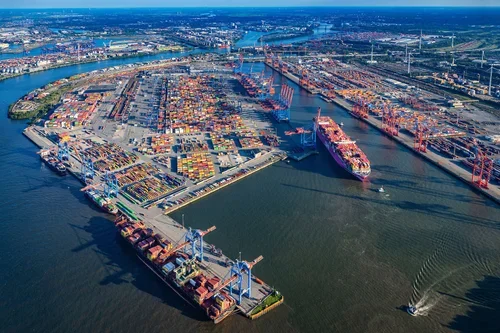
Recent events have already exposed the sensitivity of some European ports to climatic operational disruption, with access to the Port of Hamburg (pictured) having faced several bottlenecks thanks to droughts lowering the draught of the Elbe river. “We need to keep the water situation on the river in mind,” said Jens Meier, Hamburg Port Authority CEO. “We have to broaden the discussion about energy security… and resilience. Waterways, pipelines, railroads… if we want to ensure there is enough electricity, energy available, we need to keep the ports up and running.”
European port authorities must integrate and work more closely together if the continent is to become more resilient. Boudewijn Siemons, VP Europe at Port of Rotterdam, called for a degree of “master-planning” to intelligently integrate European supply chains and energy systems. “We need to be more Europe, not less Europe.
"We have created a fossil dependency that flows through our energy system, it flows through the US. Our prosperity is built on energy, it’s that simple. In Houston, they are building blue ammonia projects, to supply Europe.”
Panellists expressed disappointment at the delay in the IMO net-zero framework (NZF), but agreed that if it should be adopted, Europe must roll back its Emissions Trading System (ETS) in response. “The aspiration would be to have the NZF as soon as possible,” said Siemons. “The IMO is the only organisation that can set a global standard. Like with low sulphur fuel oil -- IMO made a law, and shipping did it! So if IMO sets an NZF, that’s where the world will go.
“I would like it to be as strict as possible. Let the price of sneakers will go up a couple of cents. [Then], as soon as possible, we will have to lift ETS. I’m in favour of ETS but in an industry like shipping, it distorts the framework.”
Senior Supply Chain Analyst at S&P Global Ines Nastali argued that funds raised from shipping should be re-allocated to supporting shipping’s transition, for which ports, particularly in climate-vulnerable nations, would be recipient. “I’m disappointed that the existence of the EU measure didn’t push the NZF more,” said “I think it can only work with a market based measure.”
The green transition itself would be slowed by blockages in the supply chain. “We see raw material supply being interrupted. Unhelpfully, the situation in Hormuz has led to supply being disrupted – that leads to price increases, and makes investments [in Europe] less attractive.”
“It will be necessary to diversify supply, for resilience,” said Ebeling. “Newfoundland has abundant access to renewables, this is a port that will be developed, six days from Europe – the same distance as Russia. The more flexibility we have in the system, the greater resilience we can provide.”
“We should ask, ‘can we speed up mining critical raw materials in Europe?’ It’s messy, but otherwise we are just making other parts of the world do it,” added Siemons.