
Suez Canal container ship transits exceed 50% of pre-disruption levels
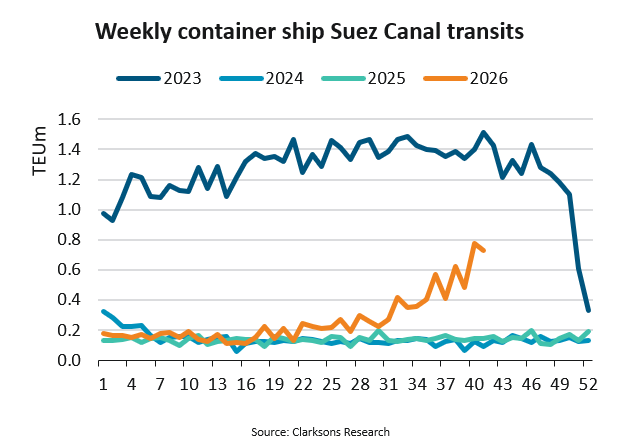
During the first two weeks of October, weekly container ship capacity transiting the Suez Canal averaged 753k TEU, according to Clarksons Research, compared with 1,457k TEU during the same period in 2023. “Since the Houthi attacks began in the Red Sea, this is the first time that transits have exceeded 50% of pre-disruption levels,” says Niels Rasmussen, Chief Shipping Analyst at BIMCO.
In November 2023, the Houthis announced that they would target Israeli ships in the Red Sea in response to Israeli attacks in Gaza. They later broadened their criteria to include attacks on other ships, which created uncertainty.
To avoid attacks, container lines began diverting ships away from the Suez Canal and the Red Sea in December 2023 and started sailing via the Cape of Good Hope. By the last week of 2023, weekly container ship capacity transiting the Suez Canal had fallen to 330k TEU, compared with the year-to-date average of 1,290k TEU.
“From early February 2024 to mid-2026, container ship capacity transiting the Suez Canal averaged 141k TEU per week, equal to on average 11% of the capacity recorded during the same weeks of 2023,” says Rasmussen.
Since the Gemini Alliance (Maersk and Hapag-Lloyd) announced on 6 July 2026 that its AE15/SE3 Asia–Mediterranean service would return to the Suez Canal, the move back to normal routings has gathered pace.
The Gemini Alliance has since announced the return of five more services to their normal routings, including its remaining three Asia–Mediterranean services. Members of the Ocean Alliance and Premier Alliance, as well as MSC, have also announced routing changes. In total, changes to 16 services have been announced since early July.
This meant that during the first two weeks of October, 36% of the total container ship capacity routed via either the canal or the cape transited the canal. This was up from an average of 8% between 2024 and mid-2026 but still a long way below the 80% recorded before the attacks began.
Initially, the increase in Suez Canal transits was mainly driven by southbound sailings. In the third quarter, capacity transiting northbound was only 75% of the southbound capacity but rose to 81% during the first weeks of October.
“We estimate that rerouting away from the Suez Canal increased global container ship demand by about 10%. That increase is now reducing quickly. However, as the return to the Suez Canal has coincided with increased port congestion in Asia, the full effect on supply/demand has yet to be seen,” says Rasmussen.