
Grimaldi Group hosts XXVII Euromed Convention
Naples-based Grimaldi Group hosted the XXVII Euromed Convention titled ‘From Land to Sea’ at the Forte Village Resort in Pula, Sardinia last week, bringing together over 700 top players from the shipping, transport, port management, automotive and financial sectors.
In his opening speech, Grimaldi Group Managing Director Emanuele Grimaldi spoke in detail about the Group’s ongoing fleet expansion, which has continued at pace over the last 24 months.
“We’ve taken delivery of 14 PCTCs (Pure Car & Truck Carriers) all of which have the “Ammonia Ready” notation, meaning they’re certified for conversion to run on ammonia as an alternative fuel,” he said. “Our fleet will have some 17 of these vessels by April 2027. The most recent of these new additions, which can carry 9,800 CEU (Car Equivalent Units), combine exceptional cargo capacity with substantially lower fuel consumption per unit transported, preparing us for the fuels of tomorrow.”
The Grimaldi Group’s development plan also includes an outlay of USD 1.5 billion to build 9 ro-pax ships for the carriage of freight and passengers, which are scheduled to join the fleet between 2028 and 2030. They will halve CO₂ emissions per cargo unit compared to vessels currently operating on the same routes. What is more, the new builds will be fitted with methanol-capable engines, allowing them to achieve the objective of net zero emissions.
Also in the last two years, the Group has extended its global network of maritime links, particularly in Asia. “Despite growing geopolitical tensions and the threat of increasingly widespread trade barriers, we currently deploy 30 ships on regular services linking Asia with all other continents. We’ve boosted our existing sailings to Europe and Africa, launched new routes to Latin America and Oceania, and introduced a new service between China and the Philippines,” Mr Grimaldi continued. “We firmly believe that open markets and fair competition are the driving forces behind prosperity and should therefore be safeguarded.”
The opening panel session discussed the theme of ‘Shipping in transition: innovation, regulation and sustainability’, with panellists Thomas Kazakos, Secretary-General, International Chamber of Shipping (ICS); Ricardo Batista, Head, Climate Action and Clean Air, IMO; Ugo Salerno, Executive Chairman, RINA; Per Håvard Siljan Hjukse, EVP - Propulsion & Handling, Kongsberg Maritime; Maximo Mejia Jr. (President, World Maritime University), and Dario Bocchetti Director R&D, Energy and Decarbonisation, Grimaldi Group.
Panellists agreed that three main issues needed to be addressed:
Technological innovation, which is essential for the development of new low- and zero-carbon fuels, such as hydrogen, ammonia and methanol, as well as for improving propulsion efficiency and electrifying port facilities;
The human factor, focusing on the people working every day on board ships, the need to engage with the new opportunities offered by Artificial Intelligence, the connections between onshore and offshore operations, and the adoption of alternative fuels; and
Regulatory clarity, particularly in light of international regulations and directives that have transformed sustainability from an ethical choice into a matter of compliance and competitiveness.
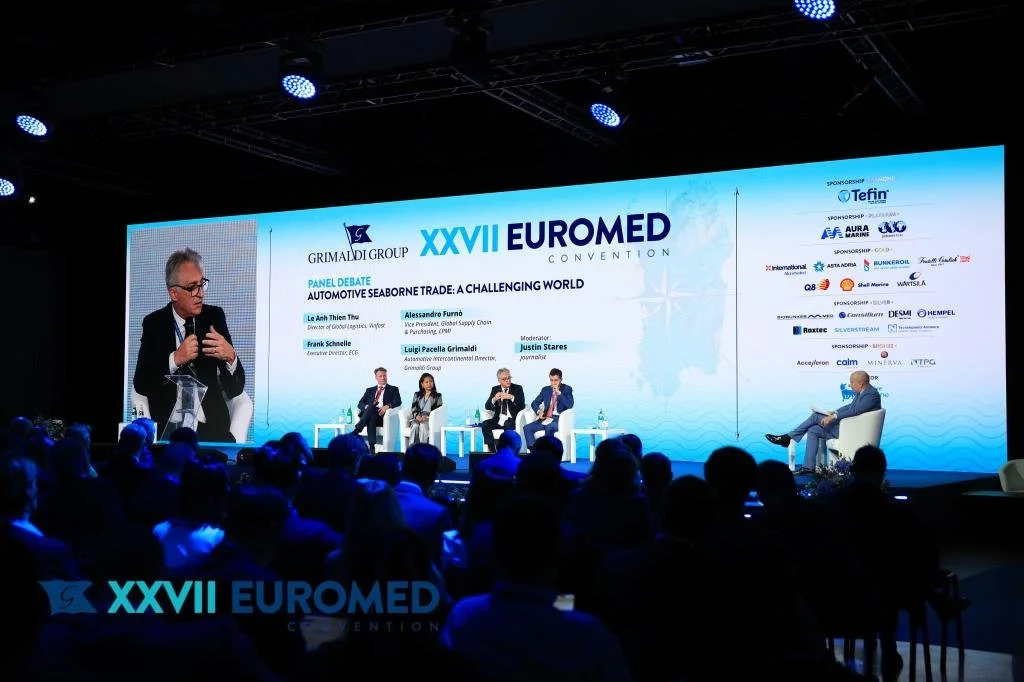
A second session addressed ‘Geoeconomic & geopolitical challenges for maritime transport in the Mediterranean’; while a third panel looked at ‘Automotive seaborne trade: a challenging world’.
The Automotive panel session (pictured) addressed three main issues:
The reconfiguration of trade flows and vessel capacity, driven by the rise of new vehicle-producing and exporting markets, especially from South East Asia, which is reshaping traditional shipping routes;
Safety and new propulsion technologies, with operational challenges related to the transportation of electric vehicles, the handling of new lithium batteries and regulations aimed at decarbonising fleets; and
The resilience of the logistics chain, with the goal of integrating maritime transport, port terminals and inland connections to ensure timely deliveries in an increasingly interconnected global market.