
Dirty tanker exports from the Americas up 40% y-o-y since start of Iran war
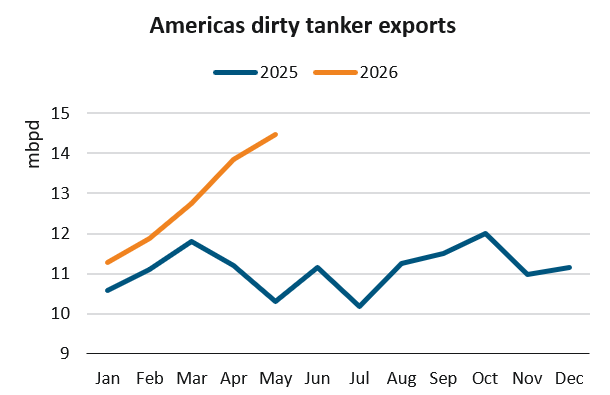
"In May, dirty tanker exports from the Americas reached 14.5 million barrels per day (mbpd), up from the previous record of 13.8 mbpd in April. Compared to May 2025, exports are up 40% year-on-year and during the three months since the start of the Iran War, exports have risen 23% year-on-year,” says Niels Rasmussen, Chief Shipping Analyst at BIMCO (see graph, source: Signal Ocean).
During March-May, countries outside of the Persian Gulf region have increased their dirty tanker exports by 9% year-on-year combined, with the Americas region accounting for 91% of the rise.
“With a 32% year-on-year increase and a 30% rise compared to January-February, US exports have been the main driver of the boost from the Americas during March-May. Exports from Venezuela have grown the fastest while Brazil, Canada and Guyana have increased their exports as well,” says Rasmussen.
Compared to 2025, the rise in exports have been driven by an increase in US shale oil production, the relaxation of sanctions on Venezuelan exports, production from new FPSOs in Brazil and the start-up of the Yellowtail field in Guyana in August 2025.
In May, East Asia edged out North America to become the main destination for dirty tanker exports from the Americas. This has only occurred twice since 2023. Combined, the Asian regions have received nearly 50% of the year-on-year volume increase during March-May. Volumes headed for Asia have grown from 4.1 mbpd during the three months in 2025 to 5.4 mbpd in the same period in 2026.
The Aframax/LR2 segment has not only been the beneficiary of nearly 50% of the total March-May volume increase compared to the same period last year, but also most of the increased volume to Asia. VLCC and Suezmax segments have each accounted for 25% of the volume increase.
Despite this, the Aframax/LR2 segment has borne the brunt of recent Americas export freight rate reductions. On average, all Aframax/LR2 Americas export freight rates assessed by S&P Global Energy are currently lower than in February.
An increase in the supply of LR2s switching to dirty trades has contributed to the rate reductions. In fact, 85% of the year-on-year increase in March-May volumes for the segment has been carried by LR2 product tankers.
“A continuation of strong Americas export volumes can help soften the global oil supply shortfall as long as the Strait of Hormuz remains effectively closed. Once Persian Gulf exports can return to normal, the strong Americas volumes may be enough to accommodate both an increase in global oil demand and the needed rebuilding of global oil inventories,” says Rasmussen.