
Stockholm’s electric flying ferry successful on all parameters, according to official report
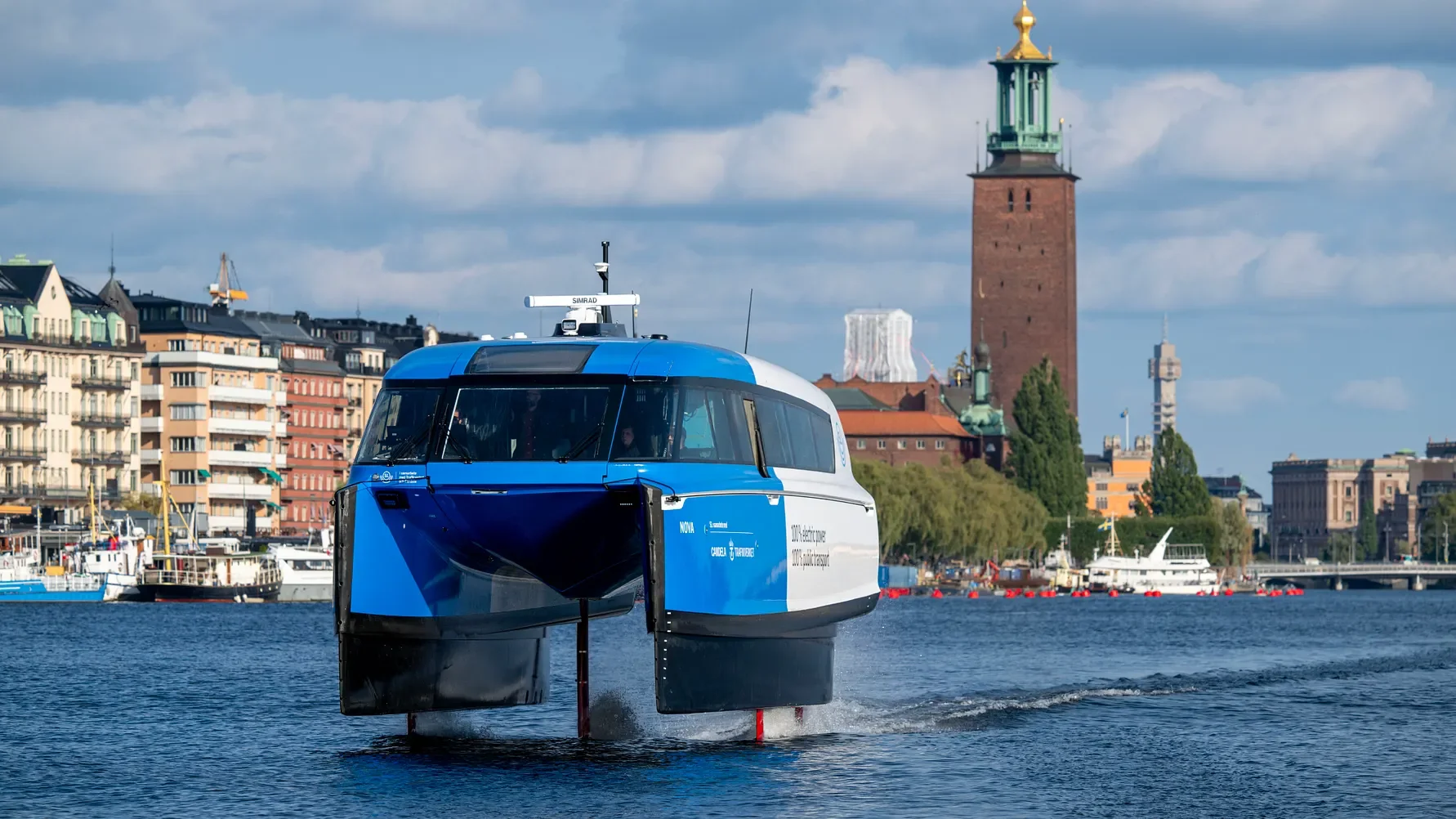
The novel flying electric Candela P-12 ferry in Stockholm’s public transport system has been declared a major success in the Swedish Transport Administration’s official report. Halved travel times, drastically reduced emissions, very satisfied passengers, and significant economic gains are reported — prompting politicians to declare it a paradigm shift in how urban waterways can be used.
Ferries in Stockholm — dubbed the Venice of the North — account for nearly half of the region's total public transport emissions, yet attract relatively few passengers due to slow journeys and limited daily departures.
To address this, the city introduced Candela’s fully electric hydrofoil ferry, the P-12, into regular SL public transport service on Route 89 between the suburb of Ekerö and central Stockholm. According to the newly released report, travel time was reduced from 55 minutes to around 30 minutes, while carbon dioxide emissions were cut by 94% compared to diesel vessels. The vessel was also highly appreciated by passengers.
In a press release, the Chair of the Maritime Transport Committee describes the results as a paradigm shift for waterborne public transport, demonstrating that services can be made nearly twice as fast while operating almost entirely emission-free.
The hydrofoiling P-12 is the first vessel of its kind in serial production. By “flying” above the water on computer-controlled foils, it dramatically reduces water drag and energy consumption compared to conventional vessels. This enables long range and high speed on battery power alone, while delivering a quiet ride and extremely small wakes — allowing the P-12 to operate at higher speeds within the city under a speed exemption.
According to the report, the P-12’s wakes measure just 13 cm — comparable to a small dinghy with an outboard motor — and significantly smaller than conventional vessels of similar size. The report recommends that future speed limit exemptions be considered to further accelerate waterborne transport in the city.
Sound measurements showed the P-12 to be as quiet as a car on summer tires traveling at 45 km/h (25 mph), and barely audible from 25 meters away. The only noticeable sound is the gentle splash of water as the foils cut through the surface.
Ridership on the line increased by 22.5%, with the novel experience attracting both commuters and tourists. Ninety-five percent of passengers rated the experience positively, outperforming other modes of transport in the city.
The report also concludes that, unlike conventional electric ferries that require extensive charging infrastructure, the P-12 system combines low infrastructure costs with lower operating and maintenance costs than diesel ferries. A simulation replacing the two current diesel ferries with six P-12 vessels showed that departures could increase to every 15 minutes instead of once per hour, passenger capacity would grow by 150%, and total socioeconomic benefits could reach SEK 119 million (€12 million), while reducing overall cost per ride.
The P-12 is already in serial production, with Candela’s Stockholm factory ramping up to 40 vessels per year. Deliveries to customers in Mumbai, the Maldives, Thailand, Berlin, and other markets are beginning in 2026.