
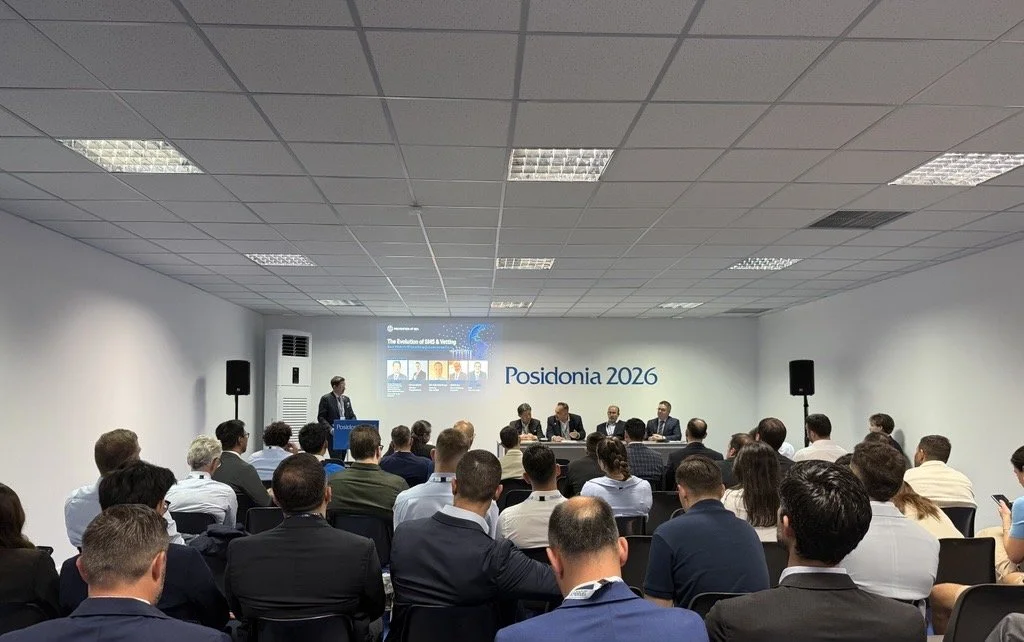
Prevention at Sea (PaS) successfully brought together maritime leaders, compliance experts, and technology professionals at Posidonia 2026 for two thought-provoking panel discussions examining the future of safety management and the growing role of artificial intelligence in shipping.
Participating as part of the Cyprus Shipping Chamber (CSC) Pavilion, PaS welcomed shipowners, managers, industry partners, and stakeholders throughout the exhibition, exchanging perspectives on the evolving challenges and opportunities shaping the maritime sector. The company's presence provided an opportunity to showcase its expertise in compliance, safety, vetting, auditing, and digital transformation, while strengthening relationships across the global shipping community.
The sessions attracted strong attendance and generated lively discussion around two of the maritime industry's most relevant and debated topics: the effectiveness of modern Safety Management Systems (SMS) and vetting practices, and the opportunities and challenges presented by Artificial Intelligence in maritime decision-making.
The first panel discussion (pictured), ‘The Evolution of SMS & Vetting: Have We Made Ships Safer or Just Smarter on Paper?’, sparked a candid conversation on how compliance requirements, vetting processes, and digitalisation have transformed over the years.
As Safety Management Systems become increasingly sophisticated and vetting requirements more rigorous than ever, industry experts examined whether these developments have translated into meaningful improvements in operational safety or primarily enhanced documentation, reporting, and oversight processes. The discussion explored the balance between regulatory compliance, operational performance, and the practical implementation of safety culture on board vessels.
The discussion featured insights from Captain Naoki Saito, General Manager and Head of Cyber Security, Ship Management Systems Department, Survey Operations Division, ClassNK; Mike Bradshaw, Executive Director, FML Ship Management Ltd; Captain Panagiotis Nikiteas, DPA/CSO/HSQE Manager, Maran Dry Management Inc. and Chair of DBCE; and Konstantinos Petrakis, HSQE Director, Chartworld Shipping Corporation.
Panellists acknowledged the significant progress made in standardising safety practices, improving transparency, and strengthening risk management across the industry. At the same time, they highlighted the ongoing challenge of ensuring that compliance requirements drive meaningful behavioural change, stronger safety cultures, and tangible improvements in day-to-day vessel operations.
The discussion raised important questions about how shipowners and managers can balance regulatory obligations with practical implementation, ensuring that safety management systems remain effective tools for risk reduction rather than administrative exercises.
The second panel, ‘AI in Maritime Decision Making: Tool or Authority?’, brought together maritime and technology professionals to explore the opportunities, risks, and realities of artificial intelligence in shipping.
From decision support systems and predictive analytics to operational optimisation and risk management, panellists discussed how AI is reshaping maritime operations and creating new opportunities for efficiency and informed decision-making. At the same time, the discussion addressed critical questions regarding accountability, transparency, trust, and the limits of automation.
The discussion featured perspectives from Eftihia Benaki, ICT Manager / CySO, IT Department, Minerva Marine Inc.; Nick Chubb, Founder and Strategy Director, Thetius; and Efstratios Arvanitidis, ICT Manager – Fleet Division, Angelicoussis Group.
A central theme throughout the session was the importance of maintaining human oversight and professional judgement as AI-powered technologies become increasingly integrated into operational and strategic decision-making processes. Panellists examined where the boundaries between human expertise and machine intelligence should be drawn and how the industry can adopt emerging technologies responsibly while preserving the knowledge and experience that remain fundamental to safe and effective maritime operations.
Both sessions generated strong audience participation and valuable insights, reflecting the maritime industry's commitment to innovation, safety, and the responsible adoption of emerging technologies. The level of engagement demonstrated the importance of open dialogue as the sector navigates an increasingly digital future and seeks practical solutions to evolving regulatory, operational, and technological challenges.