
CYTUR warns of escalating cybersecurity attacks in its ‘2026 Maritime Cyber Threat White Paper’
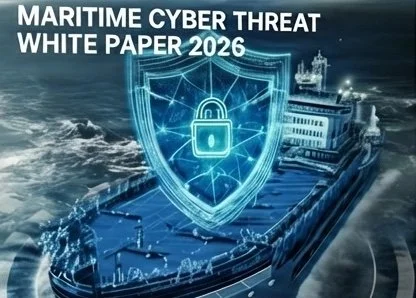
Between 2024 and 2025, cyberattacks targeting the global maritime industry rapidly expanded in both volume and sophistication, emerging as a critical variable in vessel operations. In response, CYTUR Inc., a specialised maritime cybersecurity firm, has published a ‘2026 Maritime Cyber Threat White Paper’. The report analyses incident trends from the past two years—collected via the company's maritime-specific threat intelligence solution, CYTUR-TI—and forecasts the threat landscape for 2026.
According to the white paper, the past two years witnessed an exponential increase in attack surfaces, proportional to the enhanced connectivity driven by the rapid adoption of shipboard satellite communications. The most alarming shift is the proliferation of OT (Operational Technology)-targeted ransomware. Cyberattacks that previously remained confined to IT systems are now frequently infiltrating core vessel OT systems—such as ballast water control and engine monitoring—resulting in halted operations.
Furthermore, the risk of maritime supply chain attacks has become significantly pronounced. Highly sophisticated methods have been discovered where attackers exploit vulnerabilities in the myriad of software and equipment installed onboard, potentially paralyzing dozens of vessels simultaneously through a single breach. Threats directly targeting maritime communication infrastructure, such as 'satellite communication and asset forgery,' have also surfaced. Attackers are demonstrating bolder tactics, exploiting security gaps in satellite links to transmit fabricated commands or forge vessel asset information.
CYTUR defines 2026 as the “first year of practical verification”, a period where adherence to IACS UR E26/E27 regulations will go beyond basic implementation to strictly dictate vessel delivery. Ships contracted after these IACS regulations took effect in July 2024 are expected to complete construction and begin earnest delivery this year. Consequently, while the industry previously operated in a 'paperwork' stage of compliance based on design drawings, 2026 marks the entry into a 'survival requirement' phase; failing actual sea trials and classification certifications will render ship delivery impossible.
Moreover, as threat actors are anticipated to leverage increasingly intelligent AI technologies to exploit regulatory loopholes, CYTUR emphasises that establishing ‘Cyber Resilience’ —the capability to immediately recover from an incident rather than merely building defensive walls—will become the core tenet of maritime management.
"The incident data from 2024 and 2025 proves that maritime cybersecurity is no longer an 'option' but a matter directly linked to a vessel's 'right to operate'," said Yong-hyun Cho, CEO of CYTUR. "This white paper will serve as a practical guide to help stakeholders accurately understand the massive wave of regulations and the rapidly increasing types of attacks, enabling them to respond proactively."
The full white paper, featuring detailed analyses of the 2026 maritime cyber threat landscape and CYTUR's specialised solution proposals, is available for download on CYTUR's official website (www.cytur.com).