
Suez Canal welcomes return of large container carriers
In late December, the Suez Canal Authority announced the commencement of a new phase in the return of containerships affiliated to major shipping lines to transit through the Suez Canal.
On December 23, the Canal witnessed the transit of the mega container ship CMA CGM JACQUES SAADE, one of the world's largest container ships, as part of the southbound convoy, while the container ship CMA CGM ADONIS, carrying 154,000 tons of cargo, transited as part of the northbound convoy, following the announcement of the full capacity return of the French Group's vessels.
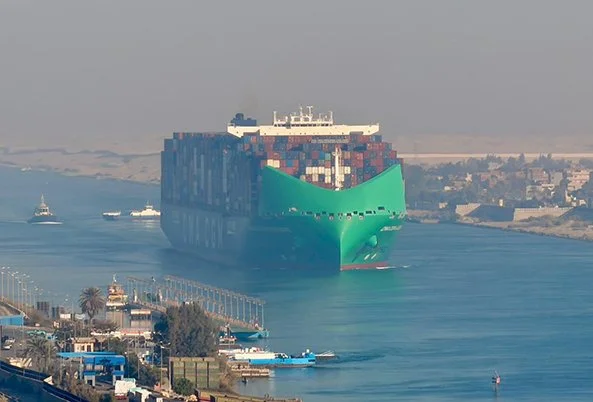
The CMA CGM JACQUES SAADE (pictured), operating on liquefied natural gas, led the southbound convoy, on its voyage from Morocco to Malaysia. This 23,000 TEU mega vessel is one of the largest container ships in the world and the largest containership to transit through the Canal in two years. The vessel is 400 metres in length, with a beam of 62 metres, and a net tonnage of 231,000 tons.
The same day, the Suez Canal also witnessed the transit of smaller containership MAERSK SEBAROK as part of the northbound convoy. The vessel transited through Bab el-Mandab strait on its voyage from Port of Salalah in Oman, bound for the United States. The vessel measures 318 metres in length, with a beam of 40 metres, a draft of 14 metres, and a gross tonnage of 82,000 tons.
Admiral Ossama Rabiee, Chairman of the Suez Canal Authority, stressed that the return of major shipping lines is the culmination of the Authority's intensive marketing efforts over the past period. These efforts resulted in the French Group CMA CGM announcing its full capacity return to transit through the Canal, and also MAERSK Group beginning its gradual return.
Furthermore, the Chairman of the Authority pointed out that these significant steps will have a profound impact on bringing about positive changes in the maritime transport market. He urged other shipping lines to adjust their schedules and resume their voyages from the Red Sea region and Bab el-Mandab strait through the Suez Canal.
Finally, Admiral Rabiee stressed that the Canal expects to see a gradual improvement in traffic rates in 2026, reaching normal rates in the second half of the year.