
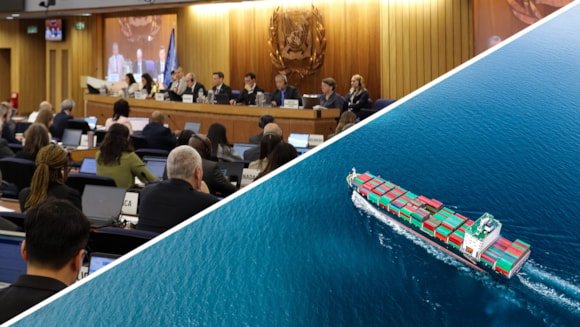
In advance of the IMO Marine Environment Protection Committee meeting (MEPC85) taking place 30 November to 4 December, shipping associations BIMCO, CLIA, IBIA, ICS, INTERCARGO, INTERFERRY, INTERTANKO, IPTA and WSC have issued a joint statement urging governments to agree a framework of global greenhouse gas (GHG) emission reduction measures for the shipping industry in order to ‘provide regulatory certainty and incentivise maritime decarbonisation’.
As representative bodies for the commercial shipping fleet, the associations say they welcome ongoing attempts to find a global framework of ‘practical, effective and fit for purpose regulations’ to help decarbonise international shipping and, whilst further improving energy efficiency, continue striving towards the 2023 IMO GHG Strategy goal of net-zero GHG emissions by or close to 2050
The statement emphasises the importance of ‘an achievable, enforceable, and stable regulatory framework which reflects cost and availability and provides clear incentives for the development and deployment of commercially viable alternative fuels’. The regulatory framework must also meaningfully support a safe energy transition through solutions which are ‘data-driven and fuel and technology neutral’, it adds.
The regulations should also provide ‘optional/flexible compliance mechanisms so that shipping companies, large and small, can manage the transition, recognising the current unavailability of commercially viable zero/near-zero GHG fuels and technologies (ZNZs) for the majority of the existing fleet’, the statement urges.
The associations recognise that ‘constructive engagement’ by all IMO Member States will be needed to develop a global solution that takes into account ‘strategic ambition’ as well as market and technological readiness’ – a veiled reference to the deep divisions between pro-abatement countries and petrostates within IMO that forced a one-year postponement of any adoption of the proposed Net-Zero Framework back in late 2025.