
Arun Sharma highlights role of classification in strengthening India’s shipbuilding ecosystem
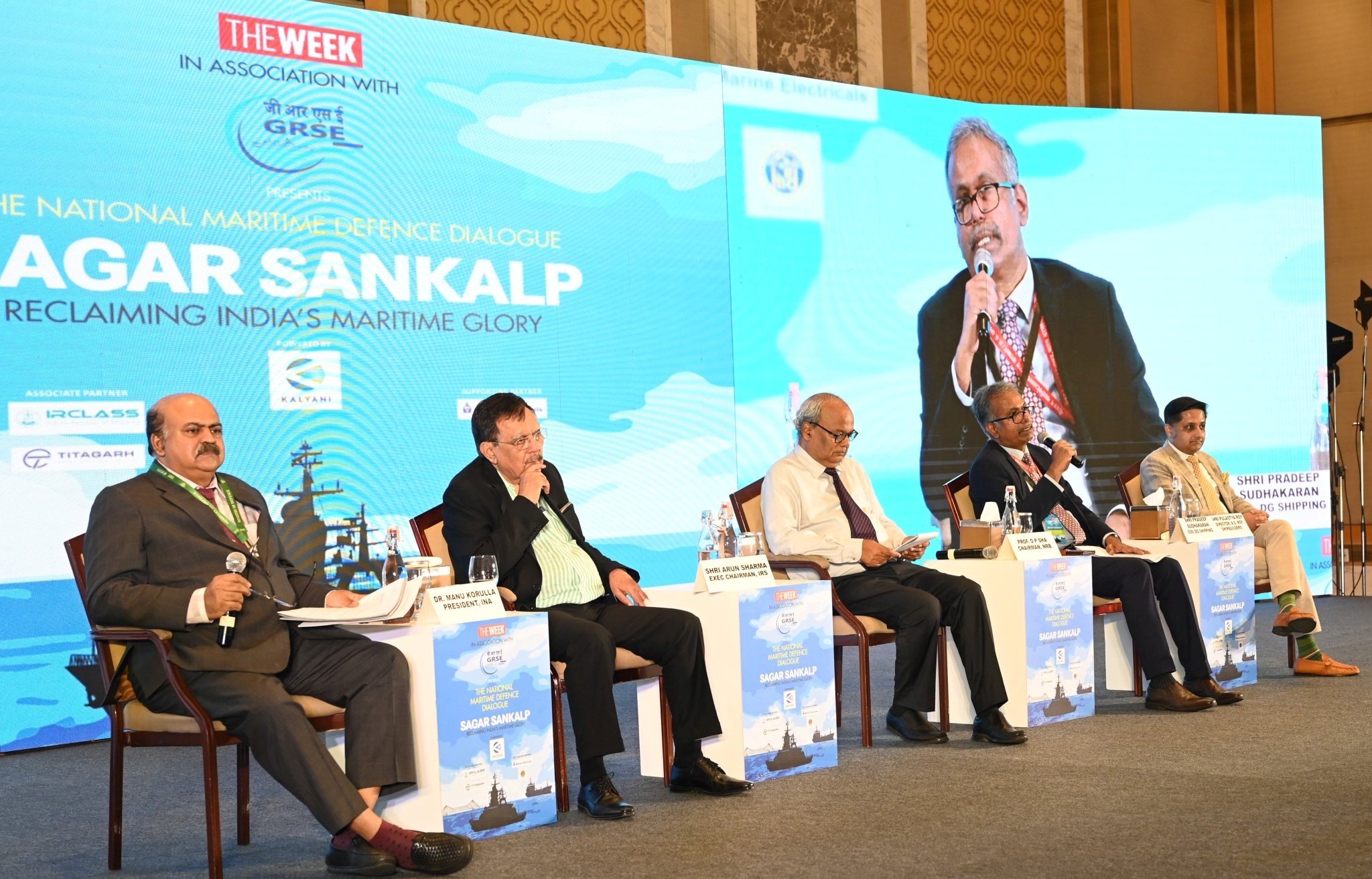
Mr. Arun Sharma, Executive Chairman of Indian Register of Shipping (IRS) and member National Shipping Board, highlighted the critical role of classification societies in supporting India’s shipbuilding ambitions during a panel discussion at the ‘Sagar Sankalp – Reclaiming India’s Maritime Glory Conclave’, organised by Garden Reach Shipbuilders and Engineers (GRSE) in partnership with The Week.
The conclave was inaugurated by Honourable Defence Minister Shri Rajnath Singh, who addressed maritime industry leaders and policymakers on strengthening India’s defence and shipbuilding capabilities. The event brought together leaders from government, defence, shipbuilding and maritime services to discuss strategies for expanding India’s shipbuilding capacity and positioning the country as a major maritime manufacturing hub.
Speaking in the panel discussion titled “Expanding the Fleet – Enhancing Range & Scale of Shipbuilding Capability,” Mr. Sharma (pictured, 2nd from left) noted that India’s ambition to become a major global shipbuilding hub must be supported by strong domestic institutions, including classification and equipment ecosystems.
Mr. Sharma highlighted that IRS has the technical capability, global recognition and institutional experience required to support the growth of Indian shipbuilding. As a member of the International Association of Classification Societies (IACS) since 2010, IRS contributes to the development of international standards governing ship construction, safety and lifecycle compliance.
He observed that globally, the growth of classification societies has historically followed the expansion of national shipbuilding industries. Countries such as Japan, Norway, South Korea and China built globally influential classification institutions alongside the rise of their shipbuilding sectors. In this context he further suggested that ships built in India should ideally be classed with IRS, while vessels constructed for foreign owners could be dual classed with IRS, strengthening domestic technical capability while ensuring global acceptance.
He emphasised that the next stage of India’s maritime growth must focus on developing a strong domestic marine equipment and ancillary ecosystem to support shipyards and enhance indigenisation. He noted that IRS can play a leading role in enabling this through standards development, equipment certification and technical support to Indian manufacturers.