
The best forecasts only count If they can be acted on in time: Weathernews
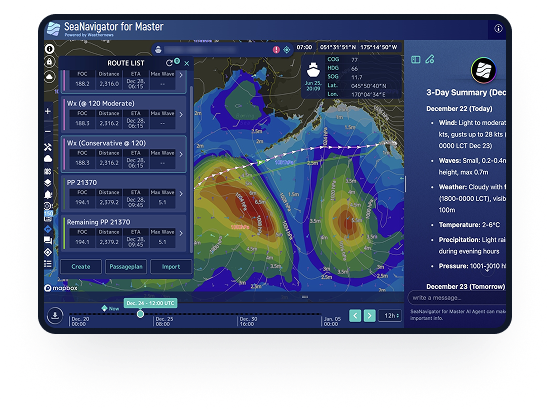
For a decade, the industry has poured its effort into improving the quality of its intelligence, writes Craig West, CEO Europe at Weathernews. Forecasting is sharper, voyage optimisation more sophisticated, and vessel performance monitored in finer detail than ever before. That progress matters, but its value depends on whether operators can act on it while it is still commercially and operationally useful. In volatile conditions, the best forecast only protects a voyage if the people responsible for it have the visibility, workflow and confidence to respond in time.
Delays carry costs that compound. A weather deviation adds time. Time adds fuel burn, and increasingly the cost of carbon. A route confirmation that arrives a day late may reach the vessel after the decision has already lost its value, and the effects rarely stop there: speed changes feed into CII performance, and CII performance into future charter selection. The intelligence behind the decision was sound but the delay between insight and action was not.
That delay often hides in routine processes: email chains, phone calls, desktop-bound systems and manual sign-offs. Each step looks reasonable in isolation. Together they can stretch a time-sensitive decision across the better part of a day. In one case Weathernews documented, a route change confirmation cycle that previously took around 24.5 hours was reduced to 30 minutes once the decision could be made via SeaNavigator Mobile.
This shows where operational advantage is now being won. And, to be clear, it is not a binary choice between better forecasting and faster decision-making. The operators who gain most are those who close the loop between bridge and office fast enough to act on it. It also reframes the onboard-versus-shore-based decision-making debate – it is no longer about where the decision should sit, but how quickly intelligence, context and the confidence to act move between the two.
This is the shift shaping the next generation of digital and operational tools in shipping. The value of putting fleet visibility on a phone, or AI-supported analysis on the bridge, is not the technology itself. It is that data, communication and decision-making finally operate at the same speed. When a shore team can respond to a route change from wherever they are, and a master can interrogate weather risk and voyage options directly, the gap between knowing and acting narrows to something close to real time.
None of this replaces good seamanship or sound forecasting. Instead, it makes them count for more. High-quality intelligence, expertise and human judgment become more valuable when connected to workflows that let decisions be taken earlier and with greater confidence. This is what adaptation looks like in practice: treating volatility as a normal input rather than an exception, and protecting time, fuel and commercial performance even as conditions deteriorate.
As margins tighten and conditions grow less predictable, the lag between insight and action is becoming one of the most expensive, and least examined, costs in voyage performance. The operators who recognise it first will not be those with the most data, but those who engineer the shortest distance between high-quality intelligence and the decisions that make it count.