
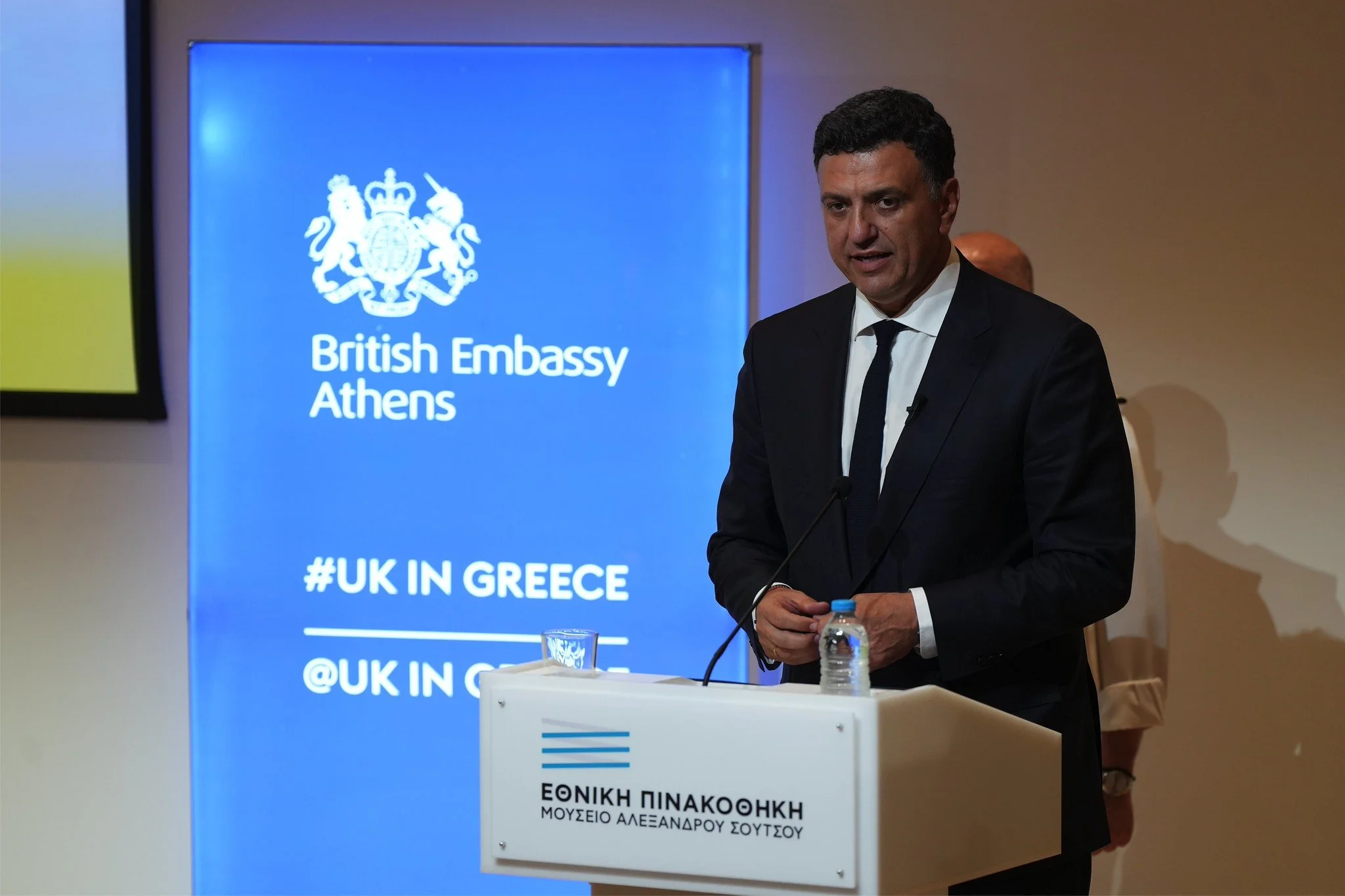
Maritime London and the British Embassy in Athens held the 9th edition of the Greek-British Shipping Forum at the National Gallery in Greece’s capital on June 2.
Welcoming the audience, His Majesty’s Ambassador to the Hellenic Republic Matthew Lodge said: “Our shipping partnership goes back many years. As we were powerfully reminded at yesterday’s [Posidonia] opening ceremony, Greek shipping plays a central role in global trade – a role of strategic importance to us all here in Europe. Meanwhile, based on deep experience and global connections, the UK provides world-leading maritime services. Together, we can be a powerful combination of fleet and expertise.”
Vassilis Kikilias (pictured), Greece’s Minister of Maritime Affairs and Insular Policy, delivered a keynote address. He said that the Greeks strongly believe in tradition and that the relationship between Greek shipping and London, built over more than a century, is a powerful example. It combines heritage with modern business, resilience and strong cooperation. Greek shipping, despite the country’s small population, remains a global leader, because it was built from the ground up by people with deep ties to the sea and a spirit of determination, he said.
The Minister added “We believe in global peace and trying to solve our differences in the best possible way with dialogues. The importance of shipping is more than obvious in the most dramatic way. If the straits are closed in one part of the globe, you get increasingly high energy prices and the prices of goods everywhere, so it affects every family, a British family, a European family. We all must have a very, very serious conversation about a common agenda.”
After thanking the Minister and the Ambassador, Chair of Maritime London Harry Theochari OBE outlined the seminar’s programme and introduced, Phillippa Charlton, Chief Marketing Officer of Lloyd's Register, who recently joined Maritime London’s Board of Directors, and Mark Williams, Maritime London’s new CEO, as panel moderators.
Stephen Gordon, Global Head of Clarkson Research, delivered a market outlook presentation, which focused on the green transition and the risks and opportunities created by disruption. Looking ahead, Clarkson Research expects long-term growth for the industry, which will be more complex, influenced by factors such as reshoring, energy security and shifting global trade patterns.
Mr Gordon said that Greece continues to play a leading role in global shipping, controlling a significant share of key sectors and investing actively in fleet modernisation, gas shipping, and efficiency improvements.
In conclusion, he said that geopolitical disruption is currently the primary driver of the shipping market, but the industry remains financially strong and resilient, and while the pace of the green transition has slowed, it remains a central long-term objective supported by ongoing investment in technology and fleet renewal.
Philippa Charlton introduced the first panel “The Stress Test – How decarbonisation technologies perform in the commercial realities of the charter market” and its participants: Kathleen Elward, VP Commercial Operations at Silverstream Technologies, James Scaife, Chief Financial Officer of NatPower Marine, Noel Tomlinson, Business Development - Commercial Shipping & Ports at BMT and Clare Urmston, Chief Executive Officer of Anemoi.
The panel discussed available technologies, which range from efficiency upgrades, like hull cleaning, wind assistance and air lubrication, to more complex solutions like onboard carbon capture. Most of these technologies are already technically viable and capable of delivering fuel savings and emissions reductions, it was agreed.
The panellists agreed that the main barrier was commercial, not technical. A key issue is that incentives are misaligned; shipowners typically invest in technology, while charterers pay for fuel and benefit from savings. This creates uncertainty over who captures the value, thus slowing adoption. However, as a result, innovative commercial models are emerging, including cost-sharing mechanisms, performance-based contracts, and charter agreements that better align incentives.
The concluding panel ‘How does nuclear power change commercial dynamics in global shipping?’ was moderated by Mark Williams, which included Alfred Butrous, Director, Global Shipping, Logistics & Offshore at Citi, Olivia Haslam, Deputy Director for Ports and Shipping of the UK Department for Transport, Patrick Ryan, Sustainability Director and Head of Club Secretariat, UK P&I Club, who is also chairing the International Group of P&I Clubs’ Nuclear Committee, Mark Tipping, Global Offshore Power 2 X Director at Lloyd's Register and Baroness Vere, Group Head Market Development at CORE POWER.
The panel concluded that nuclear shipping offers long-term potential, particularly for high-energy, long-distance operations, but its success depends on solving commercial, regulatory, financial, and societal barriers through strong collaboration between industry and governments.