
Nautical Institute (Singapore) Conference 2026 brought seaworthiness and future of seafarers centre stage
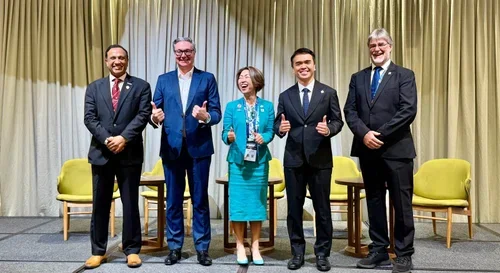
The need to look at seaworthiness beyond the physical condition of a vessel, strengthen long-term career pathways for seafarers, and keep seafarer welfare at the centre of maritime decision-making emerged as key areas of discussion at the Nautical Institute (Singapore) Conference 2026, held last week (20 August) at Furama City Centre.
Held in conjunction with the MPA Singapore Safety@Sea Week, the conference brought together over 250 maritime professionals across shipping, ship management, law, insurance, crewing, training, welfare and maritime operations under the theme ‘Seaworthiness and Seafarers in a Changing World’.
The conference was graced by Mr Ang Wee Keong (pictured, centre right), Chief Executive of the Maritime and Port Authority of Singapore (MPA), who delivered the Opening Address.
The conference featured two keynote addresses from senior maritime leaders whose careers span both the operational and strategic sides of the sector, from Mr Nick Potter (centre let), President & CEO of AET and Vice President, Petroleum & Products of MISC Group; and Sakura Kuma (centre), Executive Officer of Mitsui O.S.K. Lines, Ltd. and Managing Director of MOL (Asia Oceania) Pte. Ltd.
One of the day's most poignant moments came from Ms Kuma, who shared the story of the seafarers aboard MOL's LNG Saturn and their involvement in rescuing fellow seafarers from another vessel.
The crew remained engaged in the rescue effort for approximately six hours, working to complete the operation before sundown. Beyond the operational response itself, the account offered delegates a powerful reminder of what the maritime profession can demand of those at sea: sound judgement, seamanship, teamwork and the willingness to act when another life depends on it.
Ms Kuma’s anecdote was just one of many throughout the day, highlighting the strides the industry is making to keep seafarers top of mind, especially during challenging times.
Discussions moved naturally from the responsibilities that underpin seaworthiness and safe operations to the realities of building a career at sea, where attracting new talent is only part of the challenge. Equally important is giving seafarers the support and opportunities to stay and progress.
Against a backdrop of geopolitical uncertainty, security threats and changing expectations of life at sea, the conversations also reinforced the need to safeguard seafarer wellbeing and create working environments where people feel supported. While the challenges may differ, the thread connecting them is the same: the future of shipping depends not only on seaworthy vessels, but on the people who operate them.
Captain Hari Subramaniam (left) of The Nautical Institute (Singapore) commented: “Each year, we have had the conference growing from strength to strength and I am happy to declare that this year’s conference too had exceeded expectations with close to 300 registrations.”