
International to supply marine coatings for trio of new ferries
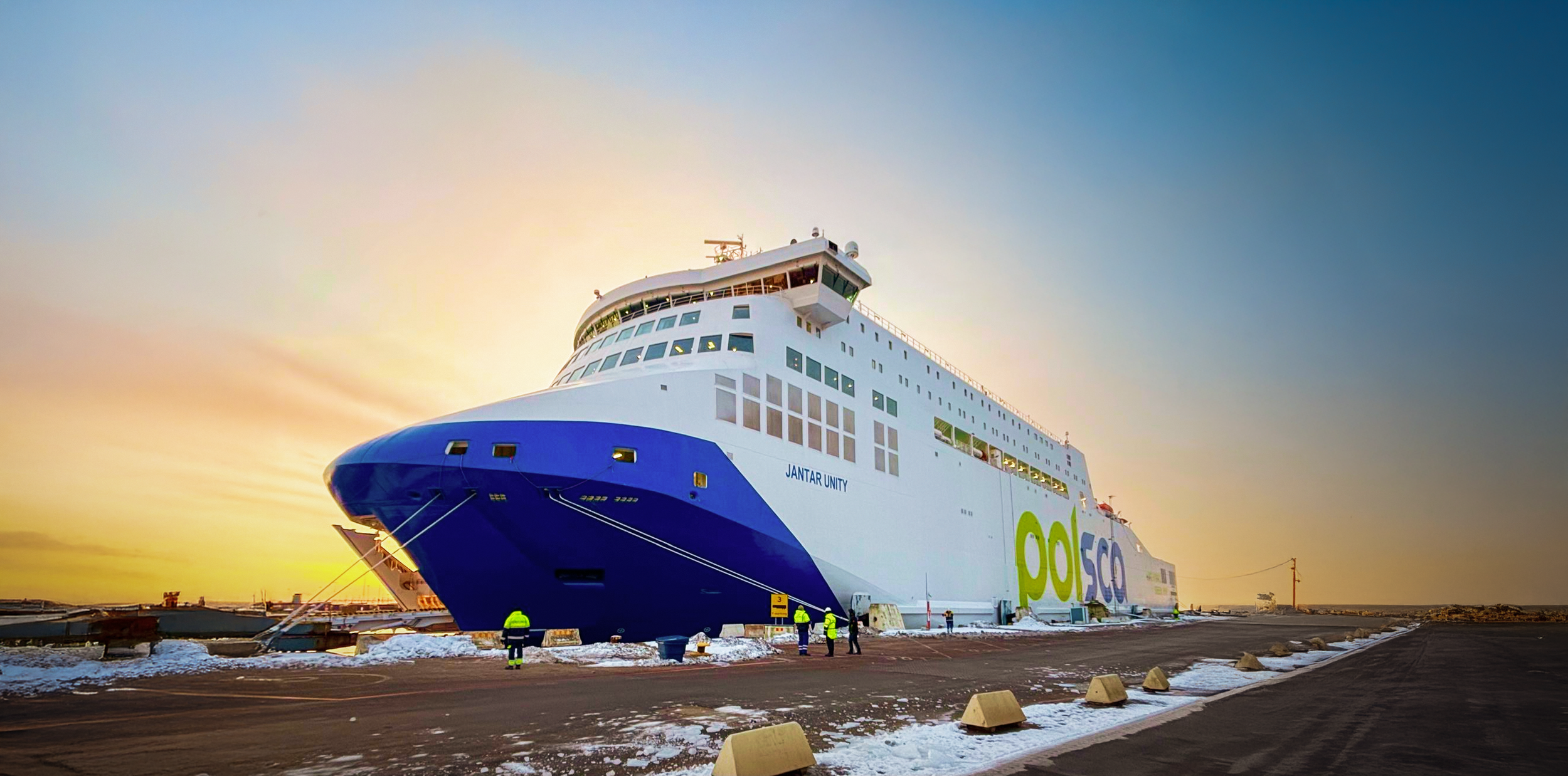
AkzoNobel’s marine coating brand International® has been commissioned by Unity Line to coat a trio of its new ferries to ensure the vessels' enhanced durability, abrasion, and corrosion protection. The first of the three ferries has just entered service on the Baltic Sea.
The Jantar Unity is a roll-on/roll-off vehicle and passenger ferry (RoPax), which sails between Świnoujście in Poland and Trelleborg in Sweden. It is protected by 280,000 liters of International® marine coatings.
Working together with Remontowa shipyard in Gdansk and operator Unity Line, the agreement also includes supplying products for a second vessel – due for delivery in the third quarter of 2026 – while steel-cutting for the third is expected to begin later this year.
“Our cooperation with AkzoNobel has a direct impact on the quality of the vessels we build,” explains Katarzyna Antoń, Head of Marketing at Unity Line. “The supplied products meet the highest standards, which is of key importance to us. It’s also significant that these proven solutions will continue to be used in the construction of the remaining ferries under the RoPax project.”
The coating system specified for the Jantar Unity included the application of Interzone® 954GF on the car decks. As an impact and abrasion-resistant anti-corrosive epoxy coating, it’s particularly well-suited for the long-term protection of surfaces exposed to heavy mechanical loads, such as car decks.
“We’re extremely grateful to our partners in this project for their trust and for choosing our high-performance solutions,” adds Mirosław Pawlik, AkzoNobel’s Sales Manager for Marine Coatings Central Europe. “We now look forward to the delivery of the remaining two ferries, which we’ll soon have the pleasure of seeing on the Baltic Sea.”
Measuring 195.6 metres in length and able to accommodate up to 400 passengers, Jantar Unity is equipped with four dual-fuel engines running on LNG and marine diesel. This helps to reduce CO2emissions, while the propulsion system operates in a hybrid configuration, which also contributes to lowering fuel consumption and emissions. In addition, the vessel complies with IMO Tier III nitrogen oxide (NOx) standards, the most stringent emission regulations currently applicable to marine vessels.