
Econowind is celebrating its tenth anniversary, with more than 170 VentoFoil units sold to shipping companies around the world. Reaching the 10-year mark highlights both the company’s journey from early start-up to established scale-up, and a broader shift in how global commercial shipping views wind power.
Over the past 10 years, Econowind has grown alongside the wider WASP market. What began as a handful of trial installations is now a recognised commercial segment, with installations roughly doubling every 12 months.
Much of that growth comes down to cost and pressure to act, Econowind says. With fuel accounting for around half of a ship’s operating expenses, shipping companies and charterers are facing high and unpredictable fuel prices, alongside the heavy cost of long-term decarbonisation. Alternative fuels such as green methanol and ammonia remain expensive, and the production and bunkering networks they require are still being built. Meanwhile, rules such as the EU Emissions Trading System (EU ETS) and FuelEU Maritime, which grants a reward factor for wind propulsion and allows operators to pool compliance surpluses, are turning emissions reduction into a direct financial case.
VentoFoils ease the load on a ship’s main engine, giving operators a practical way to reduce fuel burn and compliance costs without relying on new fuel supply chains that are still taking shape. Wind propulsion also works well alongside hull and voyage optimisation as well as future low-carbon fuels.
Looking back on the past decade, founder Frank Nieuwenhuis says: “This journey has been full of trials and learning by doing. It would not have been possible without the people behind Econowind and everyone who supported us along the way.”
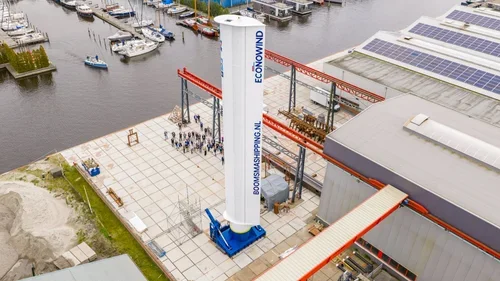
Entering its second decade, Econowind is focused on expanding its manufacturing capacity and rolling out the 30-metre steel 5-series VentoFoil (pictured) for deepsea fleets. Ten years after testing its first scale models, the company aims to help make wind assistance a standard part of life at sea.
“Wind propulsion is approaching an inflection point,” says Gavin Allwright odf the International Windship Association (IWSA), “The groundwork has been laid by technology providers such as Econowind, and the sector is now absolutely ready to ride the wave.”