
Flying ferries return to Trondheim — this time electric
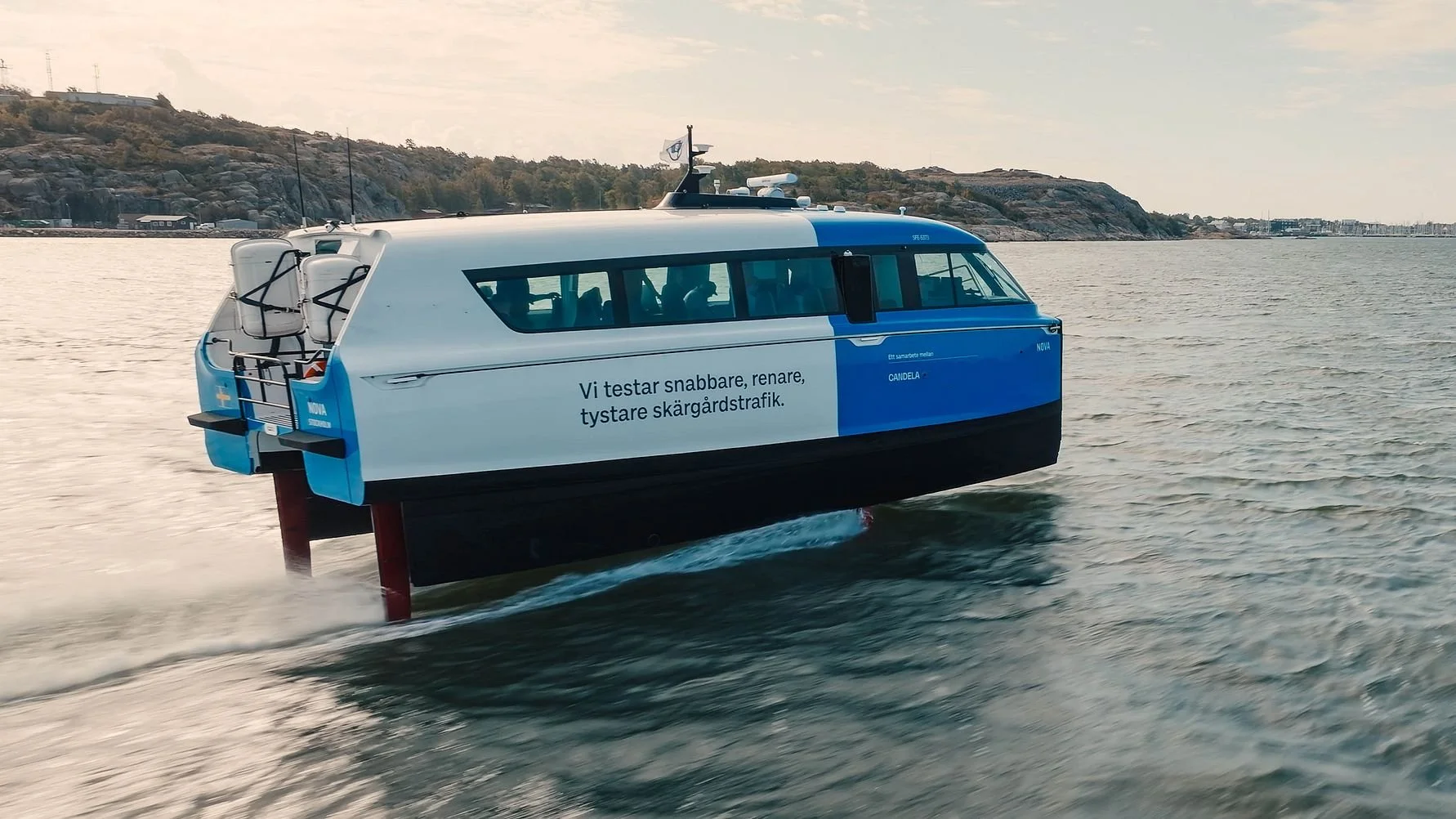
Starting on 17 December and stretching into January, the Candela P-12 — the world’s first electric hydrofoil ferry — will operate between Frosta Brygge and Trondheim as part of the Frostabåten project, a collaboration between real estate developers, Trondheim’s technical university NTNU, and the regional and municipal authorities.
With a cruise speed of 25 knots and an all-electric range of 40 nautical miles, the P-12 is the fastest and longest-range electric passenger vessel in the world. It offers a new solution to Trondheim’s — and Norway’s — commuting challenges. Fjords carve deep inlets into the landscape, making the shortest route directly across the water, but the high operating costs of ferries have meant that residents are often limited to land-based transport only.
Today, residents of Frosta — a newly built seaside community with sweeping fjord views — must travel by car or bus into central Trondheim, a journey of roughly 1 hour and 30 minutes. With the P-12 crossing the fjord, the trip takes just 30 minutes, saving commuters around two hours per day.
The Frostabåten project thus revives a much-missed ferry service on this route, which was discontinued in 1970 — and briefly operated with a diesel-powered PT-20 hydrofoil (image link) during its last year. That vessel offered fast travel times but proved too costly to run.
“We’re bringing flying boats back to Trondheim — but this time they are electric, whisper quiet, and vastly more efficient,” says Alexander Sifvert, Head of Candela’s European operations.
The P-12 is not only zero-emission; it is also far more cost-efficient to operate than traditional vessels. Its advantage lies in its efficient C-POD drivetrain and computer-controlled hydrofoils, which lift the boat above the surface, reducing energy consumption by a staggering 80% compared with conventional hulls. Electricity is also inexpensive in Trondheim, where hydropower dominates the energy mix. The result is a vessel with operating costs on par with land-based transport, such as buses.
The P-12’s efficiency also addresses the bottleneck that has slowed Norway’s otherwise ambitious electrification of its diesel ferry fleet. Despite national mandates for zero-emission fjords, strong political backing, electrifying high-speed routes has proven difficult: conventional hull electric fast ferries consume too much energy, require expensive megawatt-level charging systems, and offer limited range. The P-12, by contrast, charges from an inexpensive and mobile car-style DC charger.
“Norway is a global front-runner in electrification. With nearly 100% adoption of electric cars, the waterways are the next frontier of disruption. With our technology, that shift can not only become far cheaper than operating diesel vessels but also make new routes viable — or, as in the case of Frosta, revive routes that were not commercially sustainable when competing with road traffic,” says Alexander Sifvert at Candela.
The project is carried out in partnership with Frosta Brygge, Trondheim Port, the Ocean Autonomy Cluster, the NTNU Shore Control Lab, and others. Testing will continue from 15 January 2025 until January 2026 to evaluate the technology, operations, and potential for future routes.