
U.S. maritime leaders issue unified response to 2025 National Security Strategy
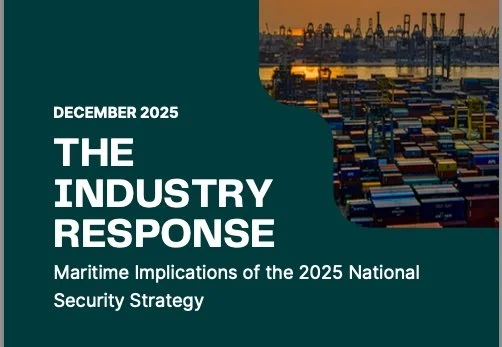
Following the release of the 2025 National Security Strategy (NSS), signed by President Trump in November, a group of U.S. maritime industry leaders have released a unified response outlining what the Strategy requires of America’s industrial and maritime base—and what is at risk if execution falls short. It is anticipated that the yet-to- be-released National Maritime Strategy and the MAP (Maritime Action Plan) will mirror the NSS.
Published by SHIPPINGInsight and authored by Dr. Beatriz Canamary of SuRe Strategy Group, the report, ‘The Industry Response: Maritime Implications of the 2025 National Security Strategy’, makes a clear case that industrial capacity is no longer a supporting element of national security—it is now central to it. The Strategy reflects a shift toward economic security, industrial resilience, and supply chain reliability as the backbone of American strength. It links future security directly to the nation’s ability to build, move goods, protect infrastructure, and scale production when needed.
One month prior to the NSS signing, 49 maritime leaders gathered in Houston at the SHIPPINGInsight Leadership Roundtable to develop an industry-driven response to U.S. maritime revitalisation. Through that process and aligned congressional analysis, five persistent structural barriers were identified as limiting U.S. maritime growth: fragmented governance and policy instability; workforce shortages and skills gaps; underinvestment in innovation and capital alignment; incentive structures that slow technology adoption; and the long-term sustainability of the U.S.-flag fleet.
The question, industry leaders emphasise, is no longer whether the United States will pursue maritime revitalisation, but how the industry will organise to deliver at the necessary tempo. A new industry-led framework now in development is designed to align shipyards with inland and coastal manufacturers; build regional hubs connecting ports, suppliers, workforce institutions, and infrastructure developers; establish a national baseline of shipbuilding capacity and workforce pipelines; accelerate port modernisation and digital transformation; and improve capital alignment for large-scale maritime infrastructure and production projects.
The report notes that federal agencies are limited in their ability to perform this coordination role due to procurement timelines, legal restrictions, and fragmented jurisdiction. At the same time, market forces alone cannot align competing companies around shared national priorities. Without a neutral, industry-led mechanism to bring these efforts together, the report warns the U.S. risks having a national security strategy it is unable to fully execute.
The urgency is emphasised by global conditions. One-third of all global shipping transits waterways, yet no major U.S. port currently ranks in the world’s top 50 for productivity. The nation also lacks a unified baseline for shipbuilding surge capacity at the moment when defense production speed, supply chain resilience, and workforce readiness are becoming competitive advantages. Meanwhile, autonomous systems, artificial intelligence, advanced energy infrastructure, and cyber-secured logistics networks are rapidly converging on the maritime industrial base, further elevating its strategic importance.
“Federal agencies can set policy. Markets can respond to incentives. But only industry can organize itself for execution,” the report concludes. “The maritime sector now sits at the center of America’s industrial future. Shipbuilding, ports, supply chains, and workforce development are no longer peripheral. They are foundational.”
The framework’s structure, governance, and implementation model are currently under development in consultation with industry stakeholders, with additional details to be released in 2026. The SHIPPINGInsight Leadership Roundtable and its growing coalition of partners are actively inviting participation from shipyards, ports, manufacturers, logistics providers, workforce institutions, technology firms, and investors. As industry leaders emphasised throughout the process, the industrial base itself has now become a national security strategy—and the time to organise is now.