
Engine retrofit capability builds as regulatory uncertainty delays conversions
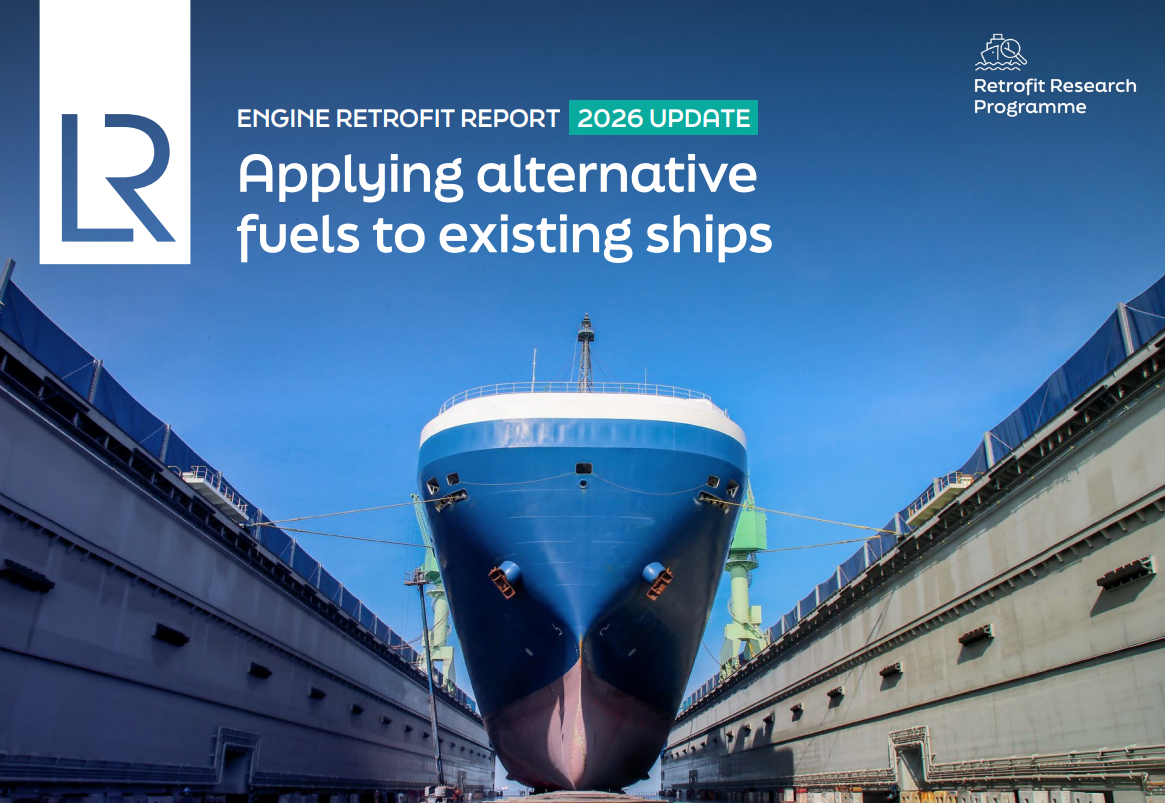
In its latest ‘Engine Retrofit Report: Applying alternative fuels to existing ships (2026 update)’, Lloyd’s Register (LR) says the longer conventionally fuelled vessels remain in service, the greater the pressure will be to retrofit them later to meet emissions targets, potentially compressing demand into a narrower and more costly timeframe.
LR’s analysis shows that 2025 delivered limited growth in announced retrofit projects, but significant progress in capability. A small number of high-profile conversions, including a successful methanol retrofit of a large two-stroke engine on the container vessel COSCO Shipping Libra, demonstrate that methanol conversions are technically viable at the deep-sea end of the market and moving towards repeatable solutions.
Alongside methanol, the report highlights expanded retrofit offerings from major engine technology providers, including Everllence, Wärtsilä and WinGD, for LNG and ethanol during the year. LNG continues to attract interest as a lower-cost, transitional option, while ethanol is gaining traction as a credible candidate for marine fuel development, supported by both operator pilots and OEM announcements.
Maersk's operator trials showed that Brazilian ethanol can be blended with methanol and marine diesel without affecting engine performance, allowing for higher ethanol mixes. OEM announcements throughout the year further strengthened the case for ethanol. Everllence reported success on all load points with both two-stroke and four-stroke engines, and WinGD announced an ethanol-fuelled two-stroke engine roadmap with retrofit applicability.
The similarity between methanol and ethanol means that future methanol engines should be capable of using ethanol, while existing methanol engines could be converted relatively easily.
The report adds that LNG retrofits remain under discussion with shipowners, supported by existing fuel infrastructure and the potential transition to bioLNG or synthetic methane. Upgrades targeting methane slip on dual fuel engines are also gaining attention.
Despite limited headline conversion announcements, the report showed continued uptake of ‘bridge’ retrofits, including engine upgrades, propulsion optimisation and control system improvements. These projects reduce emissions in the near term and prepare vessels for future fuel conversion, but also compete for yard capacity and engineering resources.
Looking ahead, LR says the trajectory of the retrofit market will depend heavily on regulatory developments, particularly any progress on a global framework to incentivise zero- and near-zero emission fuels.
Mark Penfold, Global Head of Technology – Engineering, Lloyd’s Register, said: “A clear and consistent regulatory signal is the single biggest factor that will unlock investment at scale. Without that, the industry will continue to prepare—but not fully commit.
“Regardless of the timing of regulation, a substantial retrofit market is inevitable. As the existing fleet remains central to global trade, the ability to convert vessels efficiently will be critical to meeting decarbonisation targets.”
The report forms part of LR’s Retrofit Research programme, which serves as a comprehensive hub for ship retrofitting insights, providing annual reports, publications and tools that monitor retrofitting demand, capabilities, and adoption trends.
As the industry progresses towards a more sustainable future, retrofitting may not only be a way to meet environmental objectives but also deliver economic advantages through fuel savings and regulatory compliance.