
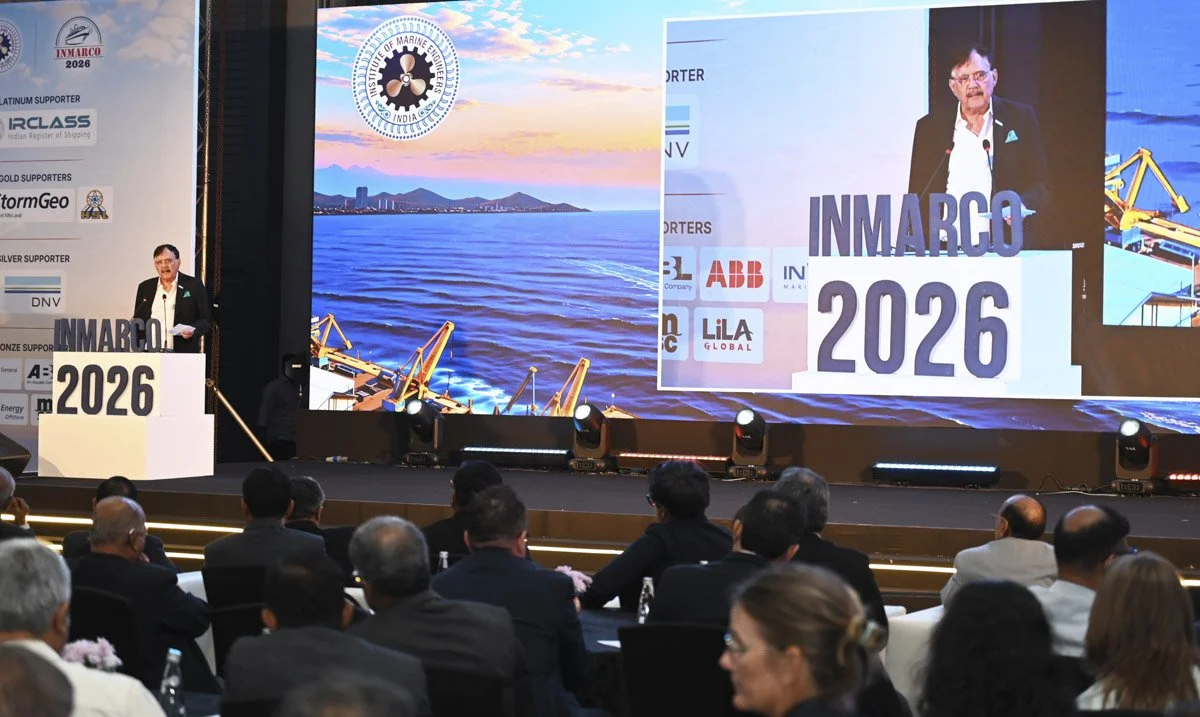
Indian Register of Shipping (IRS) had an extensive presence at INMARCO 2026, held in Mumbai from 27–29 October 2026, with senior IRS professionals participating as speakers, panellists, moderators and technical paper presenters across a wide range of sessions addressing the opportunities and challenges shaping the maritime industry.
Held under the theme ‘Maritime Landscape 2030 – Opportunities and Challenges’, INMARCO 2026 brought together maritime stakeholders from across the industry, government, academia and the technology ecosystem. IRS's participation reflected the organisation's broad technical and institutional engagement across shipbuilding, safety, ship design, alternative fuels, autonomous and digital technologies, decarbonisation, ports and maritime resilience.
Mr Arun Sharma (pictured), Chairman of the Advisory Board of INMARCO 2026, provided strategic guidance to the conference, reinforcing its role as an important platform for dialogue among policymakers, industry leaders, technology providers and maritime professionals on the future of India's maritime sector.
IRS signed a Memorandum of Understanding (MoU) with Swan Defence and Heavy Industries Ltd (SDHI) to strengthen cooperation in shipbuilding. The MoU provides a framework for collaboration between the two organisations and reinforces IRS's engagement with India's shipbuilding ecosystem as the country seeks to expand its domestic shipbuilding capabilities.
A key highlight was the release of ‘Five Decades of Building Maritime India – Indian Register of Shipping: Contribution, Capability and Global Reach’, a comprehensive report documenting IRS's journey and its contribution to India's maritime development. The report traces IRS's evolution alongside the Indian maritime sector, covering its work in maritime safety, shipbuilding, defence, technology, decarbonisation and skill development.
IRS also released ‘The Green Odyssey’, highlighting the maritime industry's transition towards a lower-carbon future and the technological, regulatory and operational pathways emerging in response to the decarbonisation challenge. The report brings together perspectives on alternative fuels, energy efficiency and new technologies.
The third publication unveiled at INMARCO was the latest edition of ‘Touch of Class’, IRS's corporate magazine, providing insights into the organisation's activities, technical capabilities, people and engagement with the wider maritime community.
Speaking during the event, Mr. P K Mishra MD, IRS said, “INMARCO provides an important platform for the Indian maritime industry to discuss not only where the industry is today, but where it needs to be in 2030 and beyond. IRS's extensive participation reflects our commitment to bringing technical knowledge, practical experience and a forward-looking perspective to these conversations.”
IRS professionals contributed to sessions covering technological advancements in ship design; autonomous ships and digitalisation; nuclear, hydrogen and other alternative fuels; maritime strategy; ship decarbonisation; maritime safety and risk mitigation; future seafarers; and shore connection systems.
IRS also presented a number of technical papers, including work on nuclear technology applications in maritime, CFD-driven assessment of wind-assisted propulsion systems, root-cause identification and risk mitigation for maritime safety, seafarers' attitudes towards working on nuclear-fuelled vessels, and shore connection systems on ships.