
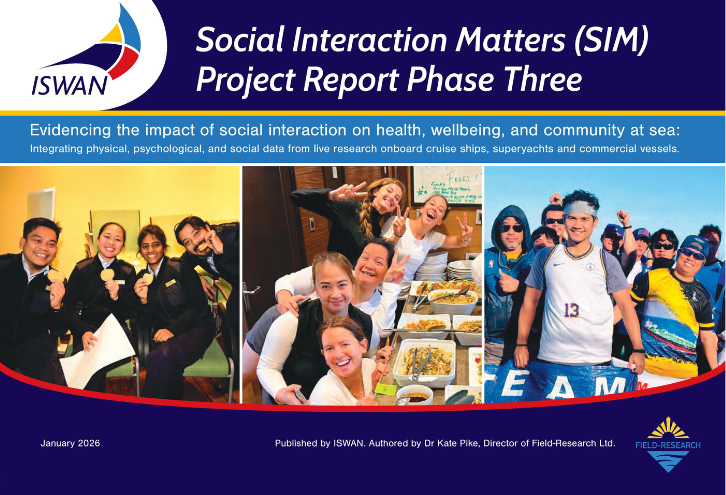
The International Seafarers’ Welfare and Assistance Network (ISWAN) has published Phase Three of its Social Interaction Matters (SIM) Project, presenting foundational research into the role of social interaction in shaping seafarers’ wellbeing across commercial shipping, cruise ships, and superyachts.
This landmark cross-industry research found that focused attention to social life on board, including having an appointed Social Ambassador from within the crew, enhanced morale, reduced stress and strengthened team cohesion. These factors are contributors to safer journeys, healthier crews, and an overall more inclusive on-board culture.
This phase marks the first time live, onboard research of this kind has taken place within the cruise and superyacht industries, making it a significant milestone for seafarer wellbeing research and industry engagement. Building on earlier phases of the SIM Project, this research expands ISWAN’s evidence base across different vessel types and operational environments.
The report highlights the critical role social interaction plays in supporting health, resilience, and a sense of belonging at sea, while also exploring the impact that persistent barriers such as fatigue, long working hours, and operational pressures have on individual wellbeing and the broader onboard culture. Experiences of social interaction were found to vary across vessel types, ranks, gender identity, and working environments, underlining the need for tailored, vessel-specific approaches rather than one-size-fits-all solutions.
Key research findings include:
- The research confirms that social interaction is a core component of seafarer wellbeing, directly influencing morale, health, and resilience. Where opportunities for connection were limited, wellbeing outcomes were negatively affected.
- Fatigue, long working hours, and operational demands significantly restrict opportunities for meaningful social interaction, despite its clear benefits. Differences across commercial ships, cruise vessels, and superyachts further demonstrate how onboard culture, hierarchy, gender, and environment shape social experience.
- Of note, women crew in the cruise and superyacht industries were differently impacted by demands, reporting higher levels of mental and physical exhaustion than their men counterparts, even after accounting for workload and sleep.
- Differences across rank were found for officers, especially those in navigation and engineering roles, who reported lower social engagement. Hierarchies of power, including perceived professional boundaries, influence opportunities for connection and participation in onboard culture.
- Welfare initiatives therefore need to be tailored to the specific needs of these groups.
- Overall, the report reinforces that social interaction should be recognised as a fundamental element of safe, sustainable shipboard operations, rather than an optional or secondary aspect of life at sea.
The study involved 176 seafarers across six vessels, with each vessel participating for three months. Data was collected using wellbeing surveys from PsyFyi and SeaQ, wearable technology from Fitbit, and qualitative insights. The participation of cruise operators, yacht managers, and shipping companies was central to the project’s success, reflecting a growing willingness within the three industries to engage in evidence-led conversations around wellbeing.
“The SIM Project Phase Three report delivers one of the most comprehensive evidence bases to date on how social connection, fatigue and inclusion shape seafarer wellbeing and safety at sea,” said Dr. Kate Pike, Research Lead. “Drawing directly on the lived experiences of crews across multiple maritime sectors, the research moves beyond compliance to reveal what genuinely supports health, resilience and performance onboard.”
The report’s findings “offer practical, scalable recommendations for operators, regulators and vessel designers, linking wellbeing to safer operations and stronger social cohesion,” Dr. Pike added. “For the maritime industry, the report provides a clear, research-led roadmap for improving working lives at sea while strengthening operational safety and safety culture.” -