
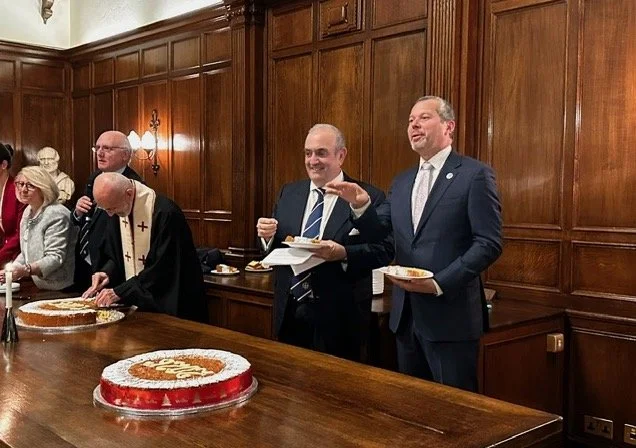
Shipping’s current decarbonisation strategy has been roundly criticised as “all stick and no carrot”, with existing alternative fuel solutions described as “haphazard”, by the Chairman of the Greek Shipping Co-operation Committee (GSCC) Haralambos J. Fafalios (pictured, centre). His remarks came at the London-based GSCC’s traditional Vasilopeta cake-cutting ceremony, held late last week n the presence of IMO Secretary-General Arsenio Dominguez (right).
Fafalios began by alluding alluded to the fact that shipping markets were generally prospering and shipbuilding yards full despite ongoing geopolitical uncertainties. But he added: “Of these new ships a certain proportion are being built to be multi-fuel suitable but without knowing if there will be sufficient green fuels available to supply them. Supply of green fuels to shipping will only be available after shore-based demand is satisfied! A larger number of vessels are being designed to be very fuel efficient using existing and new technologies and therefore making significant strides to becoming truly greener.
He continued: “Outside of the fossil fuel and biofuel solutions, including LNG and LPG, other fuels, such as ammonia, are not tried and tested or safe for that matter for the entire global fleet.
“Shipping needs global solutions and tramp shipping in particular, which encompasses the largest part of the world shipping fleet, cannot rely on haphazard solutions which are not yet there in terms of reliability and more importantly, in terms of safety.
“The carbon-free solution is still not around and will not be so for the next 10-20 years and therefore levying more taxes will not encourage a cleaner world. Those who are levying these taxes should be responsible for finding the real solutions.
“No member of the environmental lobby has come up with a workable solution for our future fuel needs. All stick and no carrot.
“With regards to IMO NZF (Net Zero Framework), unless the world shipping industry can be directly involved in the drafting of this legislation, it cannot be anything more than window dressing. More taxes only mean a greater burden for the consumer since it is they alone who will pay.
“Never forget that the world shipping industry transports more than 90 percent of the world’s commodities with the lowest global carbon footprint and with a high level of safety.”
At a media briefing the following day, Mr Dominguez stressed that IMO’s decarbonisation work was continuing but he was speaking to all parties and open to compromise over the exact formulation of the NZF. All parties should focus on what is already “on the table” and work from that, he stressed, adding that it was too soon to predict what resumption of NZF discussion in November would bring.