
As a meeting of the IMO’s Sub-Committee on Ship Design and Construction (SDC 12) closed last Friday, the Clean Arctic Alliance welcomed the clear guidance on how the IMO must reduce underwater noise pollution and its impacts, and the recommendation of a two year extension of the three-year “experience building phase” (EBP).
During SDC 12, Member States finalised a list of key technical aspects for reducing underwater noise from shipping, which will inform future policy considerations by the Marine Environment Protection Committee (MEPC) during the proposed two-year extension of the Experience Building Phase, and will be initially considered by MEPC 84 in April.
The Clean Arctic Alliance, made up of 24 not-for-profit organisations, is calling on member states to ensure the IMO continues to push for progress and action in reducing underwater noise from shipping, especially in Arctic waters where the levels of underwater noise are anticipated to nearly quadruple by 2030.
“During this week’s IMO meeting, member states agreed on clear guidance on how we must reduce underwater noise pollution and its impacts during the proposed extension of the experience building phase. At the two forthcoming MEPC meetings this year, we hope to pursue policy that will move beyond voluntary guidance”, said Sarah Bobbe, Senior Manager, Arctic Program at Ocean Conservancy, a member of both the Clean Arctic Alliance and the Clean Shipping Coalition. “So far, this work has not kept pace relative to the growing threats faced by regions experiencing increased shipping traffic, such as the Arctic, underscoring the need for parallel policy advancement through the IMO’s Marine Environmental Protection Committee in the coming months.”
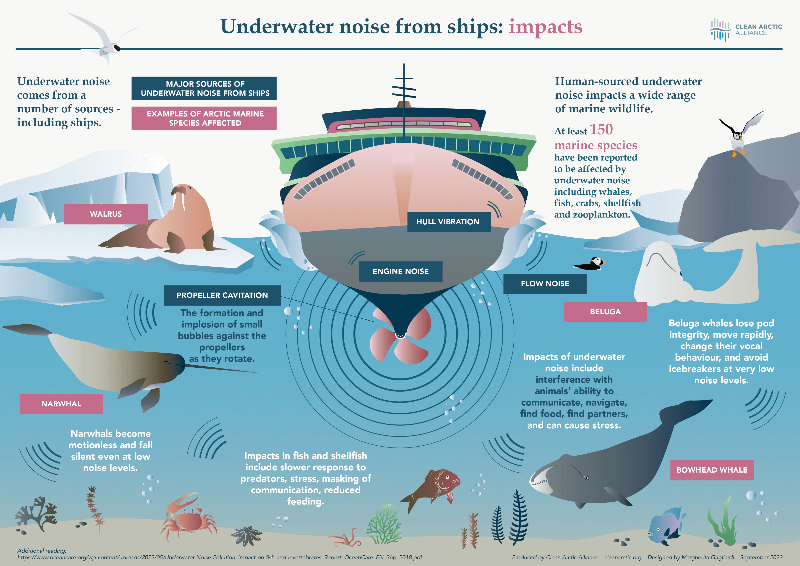
For many marine organisms sound is the most important means of communication. Under water vision is restricted and without good hearing ability, elementary functions such as navigating, finding prey and partners can be hampered. This is of particular importance for marine mammals, and also for fish and even invertebrates.
“Much of the Arctic has been free of anthropogenic (human-sourced) sound for a long time, but with increased human activity, Arctic waters are becoming more noisy every year”, said Bobbe. “An important source of noise is shipping, specifically from propellers and engines. Since shipping has increased substantially during recent decades, underwater noise is a growing problem, contributing to serious impact on the Arctic ecosystem.”